Thursday, December 3, 2009

Family Trees, Family Trunks


We have bigger houses but smaller families;

More conveniences, but less time;

We have more degrees, but less sense;

More knowledge, but less judgment;

More experts, but more problems;

More medicines, but less healthiness;

We've been all the way to the moon and back,

but have trouble crossing the street to meet the new neighbor.

We build more computers to hold more information to

produce more copies than ever but have less communication.

We have become long on quantity,

but short on quality.

These are times of fast foods but slow digestion;

Tall man but short character;

Steep profits but shallow relationships.

It's a time when there is much in the window,

but nothing in the room.

— The Paradox of Our Age, by the 14th Dalai Lama

The way everyone talked about my great grandfather and his immaculate memory, I was convinced that, had we been alive at the same time, he would have remembered me. He never forgot a name, my father said, and would systematically enquire about spouses, children and careers of relatives he was meeting after years. “Like an elephant who never forgets,” someone once quipped, and I pictured my great grandfather as a large grey elephant, all sagging skin and drooping ears, but with a nimbleness to his thoughts and words.

I was in India for my cousin’s wedding and stole away one morning to the coastal town of Pondicherry where my father spent his childhood. I knew my father had lived with his grandparents – my great grandparents – for some years before they all moved to the larger city of Chennai, and I was eager to visit the house that played host to so many of my father’s milestones, measured in dollops of mischief and ladles of pride.

The three hour drive hugged the coast line the entire way. The Indian Ocean seemed glued to my left window, punctuated by the occasional beach resort. My sunglasses kept out the sun but not the salty breeze that nested in my hair and made my shirt dance. The water roared its welcomes and warnings to me throughout, and when I finally got out of the car in front of the address I had scribbled down that morning, the tide’s rhythm continued in my head, as if a shell had affixed itself to my ear en route.

My great grandfather’s house stood before me: grey with sagging walls and drooping windows. It had responded well to sharply administered doses of neglect and the crashing tides of time. The garden was overrun with weeds and vines that now sought refuge indoors through cracks in the windows. Rust wrapped around the knee-high gate, which protested loudly when I pushed it open. Weary of stepping too heavily and disturbing the fragile state of a long-retired home, I just stared, instead. What now?

“Who are you?” asked a voice in polite Tamil, a South Indian language spoken in the area. I turned to my left and it took me a few moments to locate a small head peeping through the neighbor’s door.

“My name is Aditi. My great grandfather used to live in this house. I just came to see it. Sorry for disturbing you! I’m leaving now.” I clicked the gate closed and turned towards the car. I wasn’t sure how much more Tamil I could manage and assumed our conversation was over.

“Where are you visiting from?” he asked.

“America,” I replied. “I’m in Chennai for a wedding.”

He nodded understandingly; after all, weddings are the delightfully or disturbingly universal reason for people to visit India. But I had no idea how to say that in Tamil and didn’t try. I doubted he was interested in my social commentary, anyway.

“America! You’ve come all the way and you’re visiting for just a few minutes? Come inside, have some tea! I knew your great grandfather; he was an excellent man.”

Visiting relatives in Chennai had taught me that just as vegetable vendors and others constantly passed by people’s houses, calling out their wares in loud and resonant voices, so did neighbors between them, a non-stop shuttle of food and children and news and noise. People’s doors stayed open all day to allow the sun to draw its shadows, and were only shut at night when hungry mosquitoes took over to draw blood instead. I could imagine this man in my great grandfather’s house, spending time, eating meals, playing with the children. I was curious to know what he knew about my family.

As I approached the man’s doorway, he brought his palms together in greeting and I was moved by this kindly old man with a soft voice and thin hair, skin lotioned by sun and salt. I slipped out of my sandals and followed him into a small, neat room with a single bed, a framed picture of the elephant-headed god Ganesh, the remover of obstacles, and a ceiling fan churning the air with a lethargy that suited the sleepy town.

“Your great grandfather was a very wise man. He raised a wonderful family and taught his children to single-mindedly pursue knowledge, for that is the ultimate goal” he said in English. He spoke with a thick accent, pushing English words out of a mouth that first learned how to shape Tamil vowels and consonants, and I envied his bilinguality.

“He was a teacher?” I asked.

“He taught us all, child. Anyone who had a problem went to him. One of his favorite pieces of advice was from the Dalai Lama. Here, let me show you something.”

He disappeared into another room and returned with a framed poster titled “The Paradox of Age.” While I skimmed it he disappeared again, and I heard a clatter of cups in another room. He returned with two stainless steel tumblers of tea balanced gingerly in shallow, wide saucers. We poured the tea from tumbler to saucer to cool it, the back and forth sounding a little like the ocean, and I followed his lead and drank my tea out of the saucer, leaving the tumbler unused on the floor.

“There is much in the window but nothing in the room,” he said, quoting the last two lines of the Dalai Lama saying. “Quite often,” he elaborated, “a person believes he is in a dilemma because of how he perceives his situation. An obstacle is a hardship, but also a chance to overcome and grow stronger. A loss is painful, but also a chance to learn to live with less and separate our wants from our needs.”

I nodded and continued sipping my tea. We sat in a rare silence that was comfortable, not awkward: two strangers drinking tea out of saucers, bound by the memory of my distant relative and his dear friend, my ancestor and his neighbor. Whatever lay outside his window, there was something magical in the room.

He broke the silence. “Before you go back to Chennai, be sure to stop by the Ganesh temple. Your great grandfather loved visiting it.”

I rose and handed him the Dalai Lama poster.

“No, keep it. Your great grandfather gave it to me, and now I shall give it to you.”

I gratefully accepted with a “thank you” – I knew how to say that in Tamil – and left. The man pointed me in the direction of the temple and wished me a safe and happy future.

“Remember, a triangle can be a square that has been torn apart, or a square whose tips fell in love.” He smiled.

The temple was ten minutes away on foot, ancient and patient and comforting to step into. Right at the entrance waited Lakshmi the elephant – a real one! – who blessed me with her trunk before nudging me for some rice that sat in a sack within my reach but out of hers. She seemed to smile while she ate. Inside, I made a quick round of the main shrine to the elephant God before heading back to my car.

I left Pondicherry feeling peaceful and satisfied. I had something my great grandfather once owned and lived by; now I could learn to live by it, too. My great grandfather the elephant! I left knowing I had the blessings of not just that elephant, but many more.

Tuesday, November 17, 2009

Partying and Publishing, Posthumously

Thanks to a generous colleague (yay Mitchell!), I landed myself a front-row seat at an event at the 92nd Street Y celebrating Vladimir Nabokov and his most recent work ‘The Original of Laura’ which was published posthumously. The 2 hour program included keen insights into Nabokov’s life, poignant readings of his work and a sneak preview of what the soon-to-be-published ‘The Original of Laura’ will look like. It was a stellar cast all around.


The evening began with a 1964 recording of Nabokov reading out one of his favorite poems, “The Ballad of Longwood Glen” at the 92nd street Y. What an animated and dynamic voice he had! It bubbled with “nasty compassion” and rose with “comic fastidiousness” and pondered the mystery of Art Longwood’s strange ending. It felt surreal to hear his booming voice in the darkness, and the synchronized laughter of two audiences 35 years apart following almost every line.

Aussie Brian Boyd, Nabokov’s biographer, went next, complaining that he had a “hard act to follow”. He’s Irish and emigrated to New Zealand, which meant that for the first 5 minutes, I was just getting used to his accent. He told us how he first got his hands on ‘The Original of Laura’ some years ago when he asked Nabokov’s wife Vera and son Dmitri if he could read it. Vera finally consented, but he could only read it under her “trained eye” and wasn’t allowed to take any notes. Nabokov had instructed Vera, before he died, to destroy the book, so her hesitation was understandable. Boyd confessed last night that his own reaction wasn’t quite as straightforward; when first asked by Vera and Dmitri what to do with the book, he seconded Nabokov’s morbid opinion to destroy it. He sighed with palpable relief that they completely ignored his suggestion and kept the book alive, and indulged us with some sentences he found memorable (having since read and re-read it, with an opportunity to take notes.):

A teenage girl’s first observation of an erect penis – “…head [of the penis] turned askew as if weary of a backhanded slap he may receive at the decisive moment”. This girl’s name is Flora, who was the Greek goddess of fertility. Boyd noted that Nabokov turned that image upside down, since this female character is more like the goddess of sterility. Another sneak peek quote: Flora, naked with a man, is described as having an “exquisite bone structure that slipped into a novel…supported several poems.” I found that absolutely beautiful; how delicate yet confused a character.

The main character’s obsession with erasing himself, since his life is “an anthology of humiliation”. ‘Anthology,’ Boyd explained, is derived from the Greek word to collect flowers, and here, again, Nabokov cleverly used it in a more unappealing context, quite a contrast to the idea of collecting items of beauty.

Boyd told a story about ‘The Nabokovian’, a magazine (1 in 5, actually; so much Nabokov love in the world) dedicated to Nabokov’s work, that created a contest to see who could write most like Nabokov. Dmitri, Nabokov’s son, submitted parts of ‘The Original of Laura’, and it didn’t win. Which just went to show how new and fresh and evolving Nabokov’s writing was, always keeping the reader on his toes. Boyd eloquently and admiringly attributed to Nabokov a flair for reshaped literary structure, lucid illucidness, elegant quicksilver sentences, pointed illusion and rewritten narrative structure in ‘The Originals of Laura’. He also managed to eloquently plug his own book, ‘On the Origin of Stores’ (see Google books preview here) that addresses the ever-changing flourishes of a writer.

The second presenter was Martin Amis whose accent was easier to follow since he is straightforwardly British. He, too, has spent time with Vera and Dmitri and observed that the Nabokov family was an “equilateral triangle of love”. He read aloud from different stories by Nabokov, focusing not on the writer’s famously comic tone, but on the tragic instead, to bring out his “dementedly talented” characters, Nature’s “darkly gesticulating trees” and what he called the “Nabokovian trademark: genius expressed in a single sentence.” He quoted several sentences from Nabokov’s score of works and I managed to find a similar article of his online (having scribbled incomplete quotes in my notebook while he spoke) that contained most of the sentences, which you can (grievously) enjoy, below:
“A sick bat crept past, like a cripple with a broken umbrella.”
The couple lived in their “nice old drafty house that hung about like the flabby skin…of some fool who had gone and lost one third of his weight.”
A terrified woman during the Holocaust: “Aunt Rosa, a fussy, angular, wild-eyed old lady, who had lived in a tremulous world of bad news, bankruptcies, train accidents, cancerous growths – until the Germans put her to death, together with all the people she had worried about.”
“Only in the detachment of an incurable complaint, in the sanity of near death, could one cope with this for a moment.”
“I loathe my belly, that trunkful of bowels, which I have to carry around, and everything connected with it – the wrong food, heartburn, constipation's leaden load, or else indigestion with a first installment of hot filth pouring out of me in a public toilet…”
Chip Kidd presented next, calling himself “the comic relief,” to the amusement of a lot of the audience (some of whom I heard audibly gasping at the quotes brought to life by Amis). He has designed book covers for 23 years and currently works at Knopf, which is publishing Nabokov’s ‘The Original of Laura’. Kidd took us on a journey of book cover designs for past books by Nabokov, the author’s passionate reactions (mostly of dislike) to the covers, and culminated with the thought process behind what ‘The Original of Laura’ will look like when it’s published. He read aloud excerpts of letters from Nabokov to book designers and I quote a few below – bear with me, for I simply scribbled as Kidd invoked Nabokov’s sneering disdain.
To Penguin: This “corny caricature is meaningless…repulsive and badly drawn…use another company’s design or omit picture altogether.”To Harpers: “Time is passing and I still have not seen jacket, blurb and design…I trust there is no Russian stuff – churches, pagodas, samovars – being considered?...Such were inflicted on me by an English outsider…”Referring to a “jacket with the mauve beatnik…horrible, disgusting and tasteless...No pictorial effects...Lettering is hideous.”Referring to a book with flowers on the cover: It looks “like a ghastly vulva…emphatically against this design…Why don’t you use the simply drawn design I made for you?...Multiply or stylize them, don’t Freudianize them!...innocent blossoms.”When the laughter subsided, Kidd had the last line: “I’m happy that I started designing his book covers after he died.”
You can see the final cover design on the Wiki page for ‘The Original of Laura’ (the link is posted in the 1st paragraph). The book is noted “A novel in fragments” at the bottom of the cover since Nabokov only got as far as writing each paragraph of the book on index cards. About three-fourths of the cards are numbered and the rest either aren’t, or follow a different ordering scheme of letters. Each card is written on in pencil in Nabokov’s delightful handwriting, and we were able to see a few after the event that were on exhibit. The book will have copies of each note card on the top half of the page, and typed text below it, and Kidd has created a ‘punch out’ effect in the book, so if the reader wants to “punch out” the index cards and rearrange them – as Nabokov did as he put his stories together – the reader can.

The evening ended with a Boyd doing a reading from the beginning and middle of the book. Each turn of phrase had the audience chuckling, cringing or groaning. Nabokov may longer be with us, but his writing still packs a strong punch.

Wednesday, October 21, 2009

Final Dedications

[Cairo]

What better way to complete a solo vacation than to be able to dedicate specific moments to specific people? Thanks to Nancy's friends, you find yourself doing a Breast Cancer Awareness walk at the Pyramids, a far cry from Central Park. There are groups of people from all over the world, of every age, and everyone has a friend or relative to whom they are dedicating this hot, dusty, dry day. You think of someone back in the USA and imagine her walking with you, head held high, one deliberate step after another, admiring the Pyramids and casting aside her sickness to be a strength to you and everyone around her.

Sameer, of earlier posts, takes you on a drive through Cairo in his trusty, beat-up car -- the Batmobile, he calls it with his ineffable grin. You leave the traffic for the quiet of a mountain where the Zabbaleen live -- the Coptic Christian community of Egypt who collect the city's trash, and there is a lot in this crowded metropolis. You drive slowly through the hill, stopping to let people pass, they are hauling large bags into small godowns. The trash used to be fed to the pigs who crawled the hills, but the Swine Flu induced a nervous Muslim (and, so, anti-pig) government to kill most of them off. At the top is a beautiful church carved out of the mountain rock, and you have a quick cup of tea before going inside for respite from the dust and dirt further down the mountain. You leave the dark streets and the soot-covered men sucking slowly on hookahs for the Christianity that glows at this higher, more pristine altitude. The church is empty but peace echoes through the cave. In an adjacent outdoor auditorium, some sort of class is being conducted for young children who listen avidly to their teacher speaking about Jesus Christ. You think of someone back in the USA and imagine him walking with you, keenly and quietly observing each carving and painting, drawing strength from it as you draw strength from him.

It is your last night and the Nile laps at you, asking you to stay a little longer -- or so you hope she is saying, anyway. Men still stare and call out to you, one walks directly in front of you, cutting you off, making you stumble. You laugh it off -- you've made it this far, seen shooting stars in a desert, lunched in a local's home, drank the freshest mint tea, slept sitting up in a train, hitch hiked with a complete stranger, lost and found your way back to Cairo, been scammed by taxi drivers and used your 10 words of Arabic to get around. This moment is dedicated to your father who was bitten by the travel bug long before you showed up, and successfully infected you and your siblings to continue wandering, discovering, reveling.

Inshallah.

Tuesday, October 20, 2009

Colors of the Redbow

[Basata Eco Lodge, Sinai Peninsula]

You’re on another early bus ride, this one headed not to the desert, but to the sea. It’s an hour blur and you are asleep for a lot of it, drugged, almost, and the boy sitting in front of you has to shake you awake each time someone comes by to check a ticket or passport. You respond to all questions with ‘Basata’ and a display of your ticket. But one policeman wants to know everyone’s nationalities – whether the bus is sufficiently foreign and if there are any Israelis on board. “Israeli?” it sounds like he’s barking, and your ticket doesn’t answer his question. Quickly flourishing your American passport, you soften his gaze, he approves with a “mesh” and moves on to the next passenger.

The British-Egyptian girl you noticed at the bus station in Cairo strikes up a conversation. She came to Cairo for a graphic design job but quit when she was told she had to forge signatures. Unemployed and broke, she’s figuring out what to do next. Turns out she’s a wild London girl with a penchant for punching people who irritate her. Her track record includes kicking an unrelenting drunk at her local pub in Londong – “I told him not to touch me, innit?!”– and smashing a beer glass in his face. “I just switch, you know, I can’t control myself!” she explains with an ease and confidence you envy. It’s clear she hangs tough.

The incessant wail of prayers over the bus speakers filters in and out of your dreams. Eventually the prolonged drone – you once considered it musical and relaxing, but now it’s become a nuisance – is replaced by a deafening television. You are treated to an Egyptian movie but its slapstick comedy, dangerously similar to that of an Indian movie, doesn’t captivate you like the scenery outside your window: jagged mountains and glimpses of the Red Sea are far more enticing.

You arrive at and continue from Taba , with signs for Nuweiba indicating you’re not far from your destination. Several campsites invite you to their bit of beach, from Diana Beach to Read Sea Star. Signs greet you , “Wel Come” and are painted on colorful boards and on mountain sides.

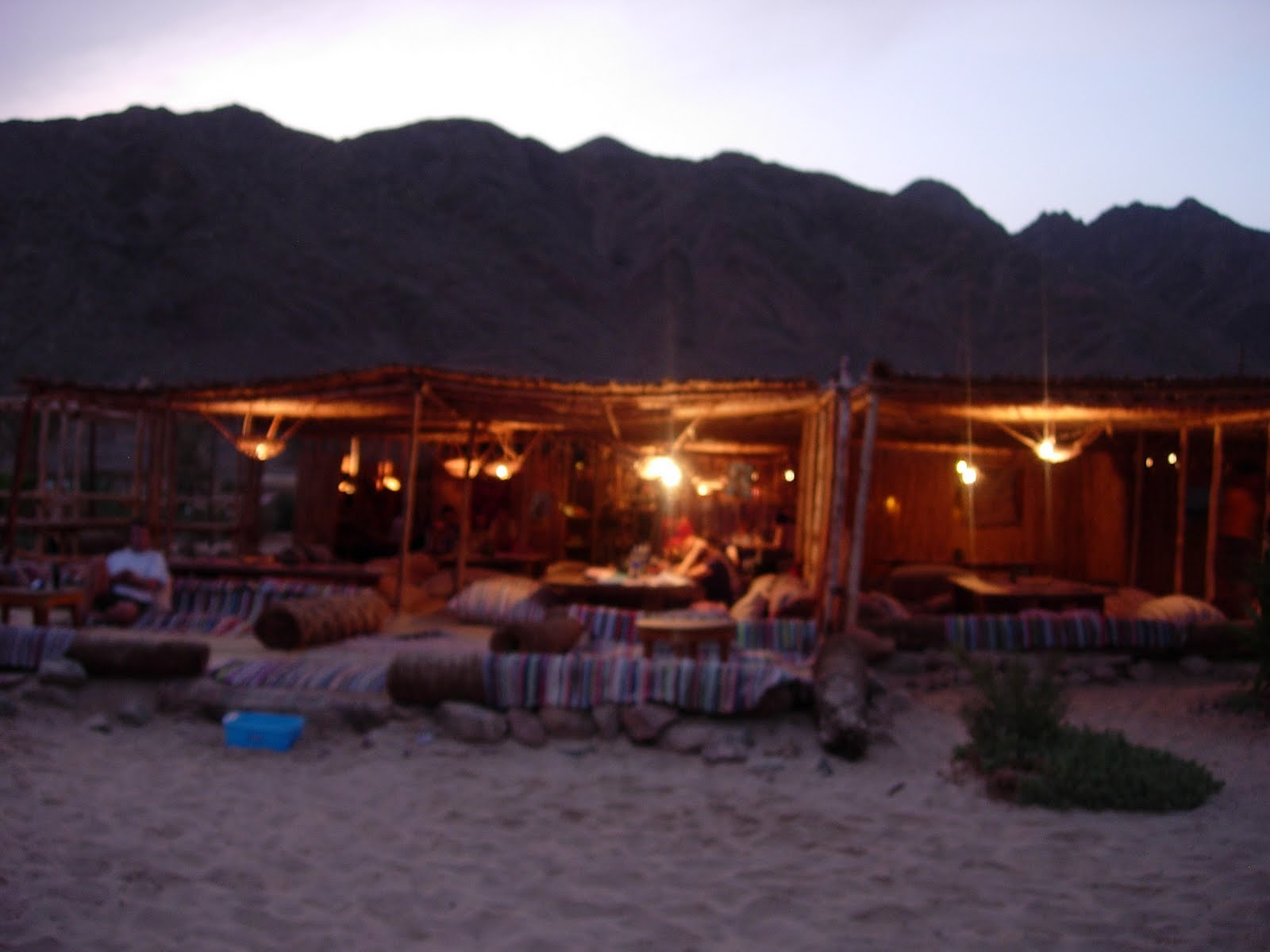
The bus stops at the ‘Basata’ sign and it takes you 5 minutes to walk from the main road to the center of this eco lodge. You are upgraded in the lodges’ books from ‘Mrs. Bus’ to ‘Aditi’ since the Bedouin who answered your call the night before speaks no English, German or Arabic, booked you as such.

Your hut is beautiful and 20 paces from the Red Sea. As the sun sets behind the mountains on the other side of the main road the sea gets ready for cocktail hour. Her tide becomes noisier and she puts on a new outfit showcasing the many blues in her Red. Couples, families with young children and older solo travelers – almost all German – relax along the beach and on the couches near the kitchen.

With the perfect timing one lucks upon with spontaneity and an empathetic Mother Nature, you set off for a walk along the beach as far as the red rocks scattered further north in time for a display of color and breeze. You know this is north because the sun has dipped below the mountains on the other side of the main road, streaking the sky orange, then pink. You spot crabs vanishing into frantically built holes – each one amidst impressive piles of hastily kicked up sand, although that could be the norm for 8-legged creatures – while the Basata cats peer intently into them. Hide-and-seek turned lethal.

You end your walk in Basata’s library and settle down with September’s New Yorker. Some pages have been curiously cut up – a school project, a cryptic ransom note? – but the Fiction piece is intact, which is all you really care about. You read under light bulbs that rest in twine baskets.

Dinner at last. You are seated 12 to a table: little Yusuf, his baby brother and his Moroccan and Kuwaiti parents; Swiss Leila who is doing a year of social work in Basata; her Egyptian colleague; the beautiful and soft-spoken Lebanese couple; a quiet German man; a German teacher on sabbatical and you. Quite the UN gathering. Food is copious and flavorful, fresh, hot and healthy. You wish you had a larger stomach to do it more justice. Rice, eggplant, zucchini, potato salad, a cole-slaw-like concoction, mozzarella sticks and fresh vegetables. You eat and learn about your table’s travel plans and backgrounds. For a while you forget you are traveling alone.

Monday, October 19, 2009

The Language of Storytelling

[Bahariyya, White Desert]

When confronted with fire, stories come to life. They glow on the faces of their authors and they flirt in the flicker of light and shadow. Why else are stories told around a bonfire so fascinating? Darkness caves in but is arrested by the heat at the core of the story circle, and the story triumphs, growing in the nighttime as everyone becomes a part of it.

An early morning, eight-hour bus ride and jeep ride later, you are two hundred miles from Egypt’s capital city of Cairo in a small, quiet Bedouin town called Bahariyya. 125 miles from there, in the White Desert, civilization comes to a full stop. Endless sand dunes are permanently prostrated before the sky, where stars dance with gay abandon through the swirls of the Milky Way and constellations look like zoomed-in connect-the-dots exercises in a children’s book.

You are here with two Bedouin guides and two tourists for one night, and it is nothing like you have experienced before, it is utterly mystical. Waagdi, your guide, makes Egyptian mint tea: the kettle sits atop the fire for what feels like hours, and its serpentine spout seems to issue a perennial supply of tea into five little cups. You are convinced Waagdi is brewing magic with a recipe of desert sand, star dust and fresh mint leaves. When the tea is ready you gather closer around the fire to drink it, feeling the heat permeate you and incite you with hope and potential: stories are born. You smiled as you exchange histories; it doesn't matter that two of you speak Korean, two more spoke Arabic and that you rely on English. Language simply happens, through fire-emboldened song, gesture and laughter.

The swirls of the Milky Way wrap around the sky like ribbon, it feels absurdly within reach. The stars are restless, they flit from here to there, you count ten shooting stars in as many minutes. Dinner leftovers have been left some distance away; sure enough desert foxes patter past you for their evening meal, shirking your camera flash as you marvel at the effervescence in the sky and the blackness on the ground.

When you awake the next morning, a large red ball of fire has started its ascent from the corner of a once hectic sky that has been scrubbed of its glitter: a clean slate for a clean batch of stories, flat as the desert you spent the night in.

Saturday, October 17, 2009

Amid the Pyramids

[Cairo]

You're meeting your friend's friend at a metro station from where you're taking a taxi to get to the pyramids. You've rushed through a brief shower—not only did your train from Luxor arrive in Cairo late that morning, but the water in Nancy’s apartment was turned off temporarily—and jumped on a train and now you’re at the station, on time, breathless. Waiting for Samir. He’s big, you were told. Glasses. Wide smile. He’ll be there.

35 minutes later, Samir arrives, his smile widening as you tap your watch impatiently. He placates you with lunch—you are also starving, you realize—and then you’re both in a taxi and on your way to see the pyramids. Yes, the PYRAMIDS! You and Samir are exchanging chatterboxy introductions, when suddenly, driving on an overpass, you think you see vague triangles in the distance. You’re holding your breath, and you release it with a whoosh. You want to ask Samir if those are what you think they are, but you point dumbly instead.

Your reverie is interrupted by a young boy who is now running alongside your taxi, now hopping into the front seat—all while the taxi is moving, of course. He starts reciting deals and bargains for you and Samir to take horse and camel rides to the various pyramids, all of which Samir wisely declines. You buy your tickets and walk through the gates and the first thing you see is the Sphinx and you fall silent a second time.

It is beautiful; never mind that the Arabic name for the Sphinx translates to “father of fear.” It is all contours and curves and eroded elegance, almost delicate. With poise and stony serenity, the Sphinx sits guard to the three tombs behind it, a preface to three triangular chapters of history, the Pyramids of Khufu, Khafre and Menkaure.

The pyramids are endless, each boulder marking an impossibility of time, strength, labor and grandeur that converged to create these structures. The scale is deafening—how did people manually drag such large stones so high up? Egyptian police loiter and assist tourists with signature tourist pictures: look look, you are taller than a pyramid!

You run back to the entrance to buy a ticket to go inside the Pyramid of Khufu. Inside it is dark, cool, almost cosy, and you snake your way down the narrow, steep sloping corridor towards the room at the center of the pyramid containing the tomb. It’s empty—robbed centuries ago, of course—which is a marvel in itself, and you have to silence your laughter when a panting tourist erupts, “that’s it?!” Yes, this labyrinth of tunnels and chambers inside this manmade Wonder of the World is it, sir. Sorry to disappoint.

You erupt from this stone volcano triumphant, elated. The pyramids! You walk the grounds a little longer with Samir, trying to get used to these steps of history slanting away from you, saluting the sun, everywhere you look. Eventually it is evening and the sun kisses them goodnight on its way down as you and Samir digest the visit over tiny cups of tea at his favorite tea shop. You’re smiling widely, too.

Friday, October 16, 2009

Nighttime on the Nile

[Aswan --> Luxor]

Back on the ship, you enjoy some moments of sun-setting silence on the roof deck. Sandwiched by trees below and smog above, the sun is squeezed of its intensity. It puts up no fight and blends into the gray-layered backdrop of dusty sky. Egyptian mythology says that the Sun God Ra is swallowed up by Sky Goddess Nut every night, who gives birth to him the following morning. Accepting his nightly fate, Ra blushes a light pink as he is dominated by the Goddess. Gliding above the silhouettes of palm trees, he pulls up his rays and blends into the sky: yellow; pink; grey. He kisses a minaret on his exit, dips behind a building and can no longer be seen. All that’s left is a pink smudge where he once occupied prime aerial real estate, an homage to his power.

Now Egypt turns the color of Islam – green. Every mosque lights up, casting an emerald glow along the Nile, announcing pinpricks of civilization along the endless river banks, heralding the start of a town or city. The ship hums along the river and you spot goats on island patches of grass and children playing on bite-sized beaches.
You dip downstairs for a sumptuous meal, some live entertainment and end up in a warm bed, your eyes still fuzzy from the golden halos over each pillar at each temple you have seen that evening.
Prayers are done for the day and the Nile takes over, whispering privately into your ears and accompanying your subconscious on its dreams.