Tuesday, September 13, 2011

War and Fiction - Speaking with Helen Benedict


Her wrists are thin, her neck adorned with pearls, her voice soft, her accent British. Helen Benedict could pass for a professor at Columbia University's Journalism masters program, but an anti-war activist with spools of interviews and notes with women from the American military? Unlikely.

Then again so is Columbia's Oral History Masters Program, I'm surrounded by its students waiting to be addressed by Prof. Helen Benedict. Familiarity suspended, I shall let her do the talking.

Her latest non fiction book is THE LONELY SOLDIER, a haunting account of how women soldiers are treated in the American military -- the Air Force, the Navy, the Marines, in school, on tour, everywhere. With her quiet voice she stresses her concerns about the military as a "rape culture" and describes her interactions with the roughly forty women she interviewed when writing the book. Most relationships deepen with time, most interviews become more revealing, but not in this case: Benedict found that her time with these extraordinary women, her questions and prompts, and therefore her voice, became the source of their Post Traumatic Stress Disorders (PTSD). How ironic that in unlocking their voices via hers, Benedict also encouraged the ghastly memories they had stashed away to scream back to life, shattering mental and emotional barriers the woman had constructed in trying to acclimatize to civilianhood.

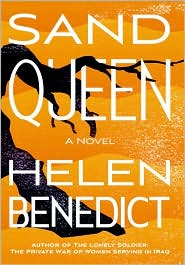
"What does remorse do to a person," Benedict wonders. What was she to do with the pages of torment she had documented, whose question-and-answer surveys only just scratched the surface of these women's stories? Her answer was to write SAND QUEEN, a fictional story tracing the lives of Kate, an American soldier, and Naema, an Iraqi woman. Benedict knew she had a plethora of detail, but she had to be careful about constructing a landscape she had never encountered, a country she had never visited, and a job she had never held. SAND QUEEN is a work "mostly of my imagination, fed by interviews," she tells us, and remembers how patience and compassion were key to winning the trust of the women she spoke with.

Fiction that is too close to the facts can "hamper imagination" and sound like "thinly veiled journalism," which Benedict wanted to avoid. It would take a fine balance of reality and its riffs to best launch her narrative and she combined her knowledge about and frustration at the war and how it was being handled, with honest questions to a female Iraqi friend: for example, "is my character angry enough." Such research helped her concoct vivid sentences, such as when Naema watches her father and brother being beaten by American soliders and taken away, no reasons given: "That is when I felt the anger grow over me like a skin," Benedict's voice making Naema sound grim.

Trained as a journalist, Benedict revels in fiction because, unlike non fiction, an author can give characters a voice that they do not have yet. One can go deeper into a character's interior, and it is always easier to "lay bare a made up character than a real person." The book is in three sections, each told by a different narrator. There is Kate, Naema, and finally a third person perspective, which is "where I get literary," Benedict explains. Kate is desperate as a prison guard in the middle of a desert, a "grey blur, dusty grey sand obliterating the horizon." Deprived of humanity in her fellow soldiers -- all men -- she befriends and talks to a tree, Marvin, "whose every twisted branch I know." Driving through the charred remains of a freshly bombed city she recalls the "corpses on the side of the road, like deer back home except with human faces." Fiction, Benedict believes, can "can come closer to the truth in profound ways," being the "old fashioned" approach to telling someone's story.

War stories belonged to men first -- Homer, Joseph Heller, Tim O'Brien -- and Benedict is grateful for the women's voices that are entering the genre today. They are still considered "outcasts," but they are an adamant and emerging community, not unlike Benedict and her followers. SAND QUEEN received all kinds of criticism: it was considered "gloomy" and "unpatriotic", not as "authoritative as a man's book," and, worst of all, made the military look bad -- although she has since spoken at West Point and engaged the government in D.C. to advocate better conditions for and treatment of women in the military, with positive responses. Benedict is inspired by the women she has come to know, whose voices and stories float through her mind, and is determined to be "fair and furious" when she writes, for them as survivors and for us as readers.

More details here: http://www.helenbenedict.com/

Monday, September 12, 2011

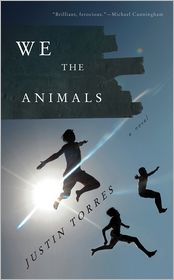
Book Reading - "We The Animals" by Justin Torres

Most writers do it. Good writers always do it. And best results are achieved if it's done in the morning.

Poetry. The perfect warm-up for a writer, to loosen his linguistic muscles and get the words flowing. Justin Torres, first-time and successful author of WE THE ANIMALS, opens his book reading at The New School with an Emily Dickinson quote: "After great pain, a formal feeling comes
—" and it is clear from the passages he reads us just how lyrical a sentence can be. As moderator Jackson Taylor points out several times, Torres' book toys with all the conventional aspects of a story -- plot, structure, character, voice -- and forces you to question them as lovingly and deeply as he does his own life and family. WE THE ANIMALS sounds (I haven't read it yet) deeply personal, but Torres is careful to separate autobiography from fiction. Certainly, characters in the book have been inspired by people he knows, but the reader should not be fooled by the use of first person. When poets use the first person, the reader doesn't immediately assume the poet is talking about himself, Torres points out, so why is fiction treated any differently?

Prodded by Taylor, Torres opens up about his life (although not as much as Taylor seems to want) and his artistic and aesthetic style of writing (I think, more exciting for the audience). He believes that events in real life do not follow a practiced and proper sequence, so why should a story in a book be told in chronological order? His books ends at a very different pace from the rest of the book, and this is deliberate:
Torres maintains that plot and structure mirror each other, so a jarring scene can be more arresting to the reader with an unexpected and dramatic structural change. The main character is a young boy and Torres plays with the idea of an "emotionally sharp child, but very limited adult" to tell the story -- the result is powerful imagery, subtle perception, pure nostalgia and innocent humor, and the little boy is totally believable. More interestingly, so is the rest of the boy's family, who could on paper read as very dysfunctional. This is a label Torres avoids. 'Dysfunction' and 'abuse' are "easy labels," too hastily attributed to family. How can a group of people who love each other be dismissed so quickly? Torres demands that the reader ask this question throughout the book, defending the inherent nobility in a family's stories and traditions -- no matter how quirky or destructive they may appear to others.

Dickinson continues:
This is the Hour of Lead --
Remembered, if outlived,
As Freezing persons, recollect the Snow --
First -- Chill -- then Stupor -- then the letting go --

Torres has remembered his past (but NOT autobiographically!), outlived his labels, stupor'd over the pages of his book, and our reward is to read chapters redolent with emotion and wonder that his protagonist will never let go of.

Wednesday, September 7, 2011

A.O.Scott at The New School: The Critic's Critique

Introducing the prolific byliner A.O. "Tony" Scott to the crowd, moderator Greil Marcus is generous and honest -- Scott has a flair for writing, can grab a reader's attention, but fashions his essays and reviews in the New York Times in such a way that the reader is often left wondering what Scott is trying to say. This is the motivation, Marcus believes, for the reader to watch the movie Scott has just written about, or to think more deeply about Scott's underlying message, and is the mark of a successful critique, but are we convinced? Scott fidgets with the papers in his hand and we wait for his response -- a collective of piqued curiosities, pens in hands poised over notebooks, underdressed students and faculty settling into the start of a new semester.

Scott begins his talk with a warning that panels on any kind of cultural criticism -- literary, performing arts, music -- tend to be "predictable, dispiriting and masochistic affairs," so be warned. He grins, clears his throat and adjusts his glasses. Who is a critic, and who deserves to provide criticism? Who is the audience, and what are they expected to know? He draws a quick comparison between mainstream criticism -- the stuff in books and print media -- and the blogosphere -- that whiny crowd of "self-credentialed elite." But perhaps the old-fashioned critics are just that, "dinosaurs," and it's the information-at-their-fingertips generation who craft more nimble opinions. Does criticism follow any rules, or does the "wide open space" of the internet that encourages such "unregulated discourse" allow for more free-flowing thought?


Visual cues help. Scott asks: who do we imagine a critic to be and recalls Anton Ego from the Pixar film Ratatouille -- a word he elocutes cautiously, giving each 't' a moment to resonate -- who, if we recall the movie, is a gaunt man, perennially frowning at the plate of food cowering before him. "Weirdly monastic," Ego is that stereotypical critic who is "devoted to an art form" but a "miserable, terrifying authority figure" at the same time -- an "intrinsic tension" ubiquitous to art and criticism. Ego's name isn't a coincidence, either; critics are known for thinking highly of themselves and for the opinions and reactions they are about to unleash upon an ignorant crowd. As the infamous Addison Dewitt from the movie 'All About Eve,' says in one scene:
Those of you who do not read, attend the theater, listen to unsponsored radio programs, or know anything of the world in which you live, it is perhaps necessary to introduce myself. My name is Addison DeWitt. My native habitat is the theater. In it, I toil not, neither do I spin. I am a critic and commentator. I am essential to the theater.
Back to that intrinsic tension: the critic doesn't toil, but he can only survive in his native habitat; the critic doesn't perform, but he is essential. When people ask Scott if it's true that all critics are failed artists, Scott jokes that in fact, all artists are failed critics. The point is, one feeds off the other: an artist is inspired by an audience's reaction to his work, just as a critic is engaged in reacting to piece of art. And so what can seem too analytical, impatient or caustic is also the critic expressing his depth of knowledge -- and, therefore, appreciation -- for something. As 20th century American critic and poet R. P. Blackmur wrote in his widely received essay 'A Critic's Job of Work,' "criticism is the discourse of an amateur." And 'amateur,' etymologically, comes from French, meaning 'lover of' or from the Latin amatorem or amator, meaning 'lover.' So, really, Dewitt's biting criticism is an ode to an art he can't live without!

Scott notes the rising "mistrust of one's own reactions" from which people suffer -- another reason for valuable criticism. Mistrust is a dangerous thing, as is mutation, but Scott -- a self-confessed "cynical, overeducated 45 year old man" -- urges the audience to respect the goal of criticism. To know enough about something and "judge fairly" is difficult, so be sincere.

In his speech 'The American Scholar' given at Cambridge University in 1837, Ralph Waldo
Emerson described the multifaceted community that is mankind, in which he asserted that "the scholar is the delegated intellect. In the right state, he is, Man Thinking. In the degenerate state, when the victim of society, he tends to become a mere thinker, or, still worse, the parrot of other men's thinking." (Read the full essay here.)

Scott concludes that criticism is not meretricious* (I had to look that up), nor should it be sclerotic** (yup, that word, too). Society thrives on debate and campaigns, especially when these originate from honest, if audacious, premises. Does Scott prefer writing a kind review or a nasty one? He quotes W.H.Auden in response: "Pleasure is by no means an infallible guide, but it is the least fallible." Coherency v. truth, scholarship v. intuition, your opinion v. mine -- such is the nature of the beast, and one which Scott will continue to explore as long as his job (a word highly disputed by 9 year old skeptics of his) will allow it!

* Apparently attractive but having in reality no value or integrity
** Becoming rigid and unresponsive; losing the ability to adapt

Sunday, August 21, 2011

Guess Who's Coming to Dinner: An Intimate Evening with Salman Rushdie

It’s neither a clipped British spittle, nor is it a noisy Indian monsoon. It’s a slippery drawl of rain that collects on the roadside so that the puddles can molest my toes. So that when a taxi driver ignores me pointedly ignoring him and idles hopefully past me, I’m left splashed and stained. The raindrops splotch my wrap-around dress but I’m not visibly dripping. Today’s force of nature is passive aggressive at best – something Mr. Salman Rushdie is not, and never will be.


Drying off inside Tulsi Restaurant, I study the rest of the gathering that has collected inside. We are bourgeois brats out and about this slow Sunday evening, eager to dine in the acknowledged proximity of Salman Rushdie, and elite enough to afford it (tickets weren’t cheap, and for that I owe my generous sister). Aroon Shivdasani, Executive Director of the Indo-American Arts Council (IAAC) and tonight’s event organizer, leads with her easy laughter, polished speech and impeccably British-Indian accent. Among the familiar and the envious, she is relaxed in a light blue kurta. In contrast, the rest of us draped in silk, satin and jackets use our indoor voices and try to act dignified.

Rushdie comes through the door, an umbrella on his arm. His small, bright eyes are tucked into an expansive forehead that has usurped most of his head. Whatever hair is left has abandoned any attempt at density except in tufts on the sides. Slight, angular eyebrows direct our attention past his tiny pupils and thin lips to a better groomed ’stache and goatee. When he smiles there is a bulge of cheekbone. He kisses cheeks and shakes hands with Aroon and her crew while the rest of us sip our wine with a fresh focus; we have paid good money for this after all. A hostess carves our crowd of 55 into tables seating 4, 6 and 8. My sister and I luck out at a table with a friendly couple from New Orleans. We are two tables away from Rushdie, who sits at the head of his with that permanently bemused look on his face.

Aroon introduces herself, the IAAC, its growing importance supporting the arts in the Subcontinent and its steady success attracting cash and (Indo-American) celebrities in America. In fourteen years the IAAC has staged plays at the Apollo, operas at the Met and most recently, the annual Erasing Borders dance festival in downtown Manhattan. Coming up is a special tour of the Vishnu exhibit at the Brooklyn Museum followed by dinner with the curator, and did she mention the two book launches next week?

What she doesn’t mention – need not mention – is the panoply of accolades decorating Rushdie’s name, like accents in the Polish alphabet. Instead she tells a story: some winters ago, a New York City fundraiser for Bombay’s street children had sold only 30 out of 200 tickets. Once Aroon “let slip” that “my friend and author” Rushdie would be attending, the show’s attendance jumped six-fold. To applause, she hands the mic over to Rushdie, who opens with a glib “Thank you to Aroon, who continues to pimp me out as the years go on.” Pause for laughter, and there are the inevitable few who roar. More acknowledgments to the IAAC, its recent half page in The New York Times this weekend and his increasingly regular “dual acts” with Shashi Tharoor with whom he “got to play the Apollo,” something he never dreamed he would do.

He dutifully shares his current projects with us. First, a film version of Midnight’s Children. “It’s taken me thirty years to say this,” for the book first came out in 1981, but the wait and the work has been worth it, and he expects it to reach the Toronto Film Festival, if not Cannes and Venice. Having praised the director and actors (the young Saleem is played by the little boy from Taare Zameen Par), he pats himself on the back for the screenplay: converting a 600-page book into a 130-page script is a trying “work of condensation;” better done by him than someone too intimidated to go at Midnight’s Children with a machete. Flirting with the idea of making two movies, Rushdie learned that “everybody wanted to finance the movie Midnight’s Children, but nobody wanted to finance two,” and sculpted his novel into a movie “two and a quarter hours long.” Movie making is a “lesson in real life,” he explains: you do whatever you can within the budget you have, and that’s it.

Second, his memoir. Never desirous of an interesting life, he insists, “unfortunately, my life became interesting,” and now it has become a book. No title and no publishing date yet, but expect to hear something next year.

“And now, I think, it is time for dinner,” he concludes, and we turn to our appetizers. About an hour and a half and three delectable courses later Aroon makes a round of the tables, beaming at everyone’s full mouths and quickly reminding us that our privileged guest is leaving so we should take pictures and get books signed now. A line has already formed and Rushdie signs books, Kindles (has it come to that?) and wine bottles with that mildly sour snarl always pasted on his face. My sister and I wait for him to wave us over, we share a few words, he wishes me good luck on my MFA and the photographer clicks twice. Next.

When we leave the restaurant the rain has slowed but our eyes are bright, our stomachs are full, we are heady with wine and the fact that we just had dinner with Salman Rushdie! Or something like that ;)

Thank you, Thangachi!

Friday, March 11, 2011

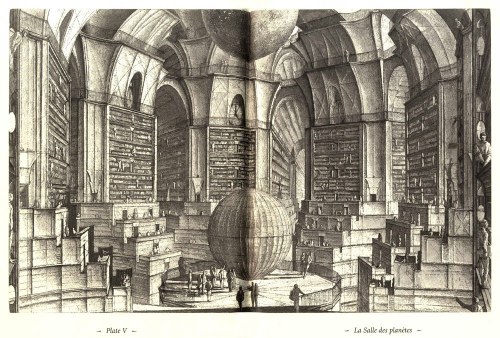
"I say that the Library is unending."

Don’t be fooled by the New School venue and the prominent writers at the podium; this event is a fundraiser for the little known Brooklyn Waldorf School where two parents happen to be Sean Wilsey and Jhumpa Lahiri (and both happen to know Jonathan Franzen), and they happen to have literary clout, and if they charge money to speak, people will come.

So here we are: arms sore with copies of Franzen’s Freedom (and, I begrudge the audience, Lahiri’s Unaccustomed Earth) we want signed, eyes sore from scanning the auditorium for empty seats and drawing near blanks. Wilsey gamely welcomes the audience and explains the importance of libraries, and libraries for children. He quotes Jorge Luis Borges—a librarian as well as a writer—whose words I must include here, because he is tremendous:

Like all men of the Library, I have traveled in my youth; I have wandered in search of a book, perhaps the catalogue of catalogues; now that my eyes can hardly decipher what I write, I am preparing to die just a few leagues from the hexagon in which I was born. Once I am dead, there will be no lack of pious hands to throw me over the railing; my grave will be the fathomless air; my body will sink endlessly and decay and dissolve in the wind generated by the fall, which is infinite. I say that the Library is unending. The idealists argue that the hexagonal rooms are a necessary form of absolute space or, at least, of our intuition of space. They reason that a triangular or pentagonal room is inconceivable. (The mystics claim that their ecstasy reveals to them a circular chamber containing a great circular book, whose spine is continuous and which follows the complete circle of the walls; but their testimony is suspect; their words, obscure. This cyclical book is God.) Let it suffice now for me to repeat the classic dictum: The Library is a sphere whose exact center is any one of its hexagons and whose circumference is inaccessible.

—Borges’ short story “Library of Babel”

Moderator Sean Wilsey, initially overwhelmed by Lahiri and Franzen’s entries in his anthology State by State, confesses to us that his praise for their pieces was received with more sedated emails from them: “you really need to try to reign in your hyperbole.” But his child’s kindergarten teacher need not, he assures us in his introduction that is anchored in the glory of libraries and literacy (hence Borges earlier). She is teaching her students the alphabet—specifically, the “spatial relationship of lower case letters”—and “baby j,” for example, “dips its feet in the water and likes to play ball.” Creativity, humor and word-making have no bounds—like Borges' library.

Time for the authors to indulge us and themselves a little. Lahiri goes first. She is precise at the microphone, holding her manuscript up firmly. She inflects such that each clause ends on a minor note, hooking lugubriously onto the next. Her excerpt is from a novel-in-progress: two urchins who have stolen onto a golf course in their hometown of Calcutta where they marvel at its manicured elitism, its “perfect little [golf ball] holes like navels in the earth.” These are boys whose youth unabashedly drives their subconscious into smorgasbords of adventure, so that they have to “[step] so many mornings out of dreams.” Another character compares the colors outside her window to the jars of Indian spices on the sill; very clever.

Franzen follows with self-deprecating and snarky remarks, already he is more appetizing: “Intergenerically; I’m going to read some nonfiction...Apologies if you’ve read it, hopefully I can add some value by reading it in my voice. I’ve never read it before…may never read it again.” He flicks a glance at us over his glasses.

“The Mediterranean,” he begins, “is nothing but extremely blue.” He is stooped over the mic, having not adjusted it after Lahiri, and looks casually at the audience, naturally lifting his eyes off the page to talk to us (I don’t mean to compare him and Lahiri, but I shall anyway). He doesn’t just frame a precise picture with poise—usually authors read only enough to give us an outline—but tells us a story easily, informally. However this is nonfiction, and after a sip of water, he dramatically unplugs a flow of facts about birds damned to extinction, and we are both amused and informed. “There ensued a blur of fighting,” he writes of a group of men confused in their confrontation. One character’s fanaticism is “matter-of-fact,” and so is Franzen when he looks up to tell us that “it’s just really stupid” to hunt migratory birds in the Spring when they’re off to reproduce. Later he can’t tell if a bird meat’s bitterness is “real or the product of emotion.”

One of my favorite lines is by a Cypriot in his piece who says, “we’re a middle Eastern country that’s part of Europe by accident.” [Read a larger excerpt in The Telegraph, here.]

Back to Wilsey to address questions of his own and from the audience to the authors sitting on either side of him, and he is utter unpreparedness is visible in the boy’s smirk across his face. Franzen responds with witty impatience, masterfully trading words for silence, lost in thoughts and gazes before speaking. Stalling humorously, Wilsey circuitously asks the authors about geography. Franzen talks of investing his characters—often Midwestern—with “explanatory power to make life more interesting…our own watered down version of myth.” Lahiri says that geography “is increasing for me as a preoccupation of work.”

In the case of Fiction v. Non-Fiction, Franzen argues that Non Fiction is “playing the game of writing, waiting for something to happen,” whereas fiction “seems somewhat indulgent” since the author gets “really involved in stuff you’ve made up”. But he is clearly an author since he finds “straight up journalism...incredibly confining.”

One Brooklyn Waldorf parent to another, Wilsey asks Lahiri about kids. She advocate reliving childhood through them since it’s “nourishing to question things, struggle with things.” Fiction writers are “repeatedly decoding the world, an unsolvable puzzle,” as parents do for their children.

Paradoxically, Franzen claims to hates research and Lahiri believes that when writing there is “some sort of research going on continuously to create a life through language.” Franzen teaches us that when Kafka wrote Amerika (aka The Man Who Disappeared) set in Oklahoma, “Oklahoma was just a word he knew.” He thinks for a moment. “I don’t think he did too much research on bugs either.”

PS. Happy Birthday, Anusha!

Tuesday, March 8, 2011

Carnatic Music at the UN

In a large auditorium in the EcoSoc building, where the East River Breeze can’t find us, we arrange ourselves in rows behind long desks, eager on this Wednesday evening for a concert guaranteed to impress. Dignitaries and civilians mill about me, shaking hands and smiling, knowing they are being observed. The room buzzes gently with polyglots whose passports are as thick as their resumes are long; I’m helplessly impressed.

Promptly at 6:45 p.m., Secretary General Ban Ki Moon greets the audience with folded hands and in Hindi, delighting the mostly Indian crowd. Living in New Delhi for three years “I learned diplomacy,” he tells us, describing the “high ambitions” he had then, that he hopes he has achieved since. “I really enjoyed Indian music when I was tired, afraid,” and used it to “relax, reflect and recharge.” Moon gestures to the empty offices surrounding us: “music can be enjoyed just as it is, that is why we don’t have interpreters here this evening.”

After a brief opening aarti, Dr. L. Subramaniam and his son Ambi are tuning their violins on stage. Father and son sit erect, smiling, relaxed. Senior introduces the pieces with a short explanation, included in the program, before beginning the performance, while Junior accompanies as a second shruti box until invited to join in. They are two violins in harmony without actually harmonizing—another irresistibly Carnatic trait. Senior closes his eyes while his fingers help us see the intricacies of a ragam; I am blinded by his speed. Junior balances his violin on his chest and leg, his arms free to keep talam and transcribe in his mind the melodies he will share.

I have heard varnams sung and performed countless times, but never in 4, 5, 6 speeds. Senior’s bow stutters over the strings with precision and clarity; Junior’s echo is equally sharp. Three notes are jammed into the space of one, but each one resonates distinctly. Senior wields 4 octaves of Kalyani at the touch of a finger, never misses a count; Junior keeps up with a smile, never loses a breath—in the end, it’s us who are breathless. Senior is supported by mridangam and moorsing; Junior jams with a gatam and tavil: being accompanied by 4 percussion instruments creates a thrilling and robust orchestra.

In between the first and last piece, Senior jokes with the audience that “in Indian concerts, a ‘short piece’ can be one to three hours, but it’s the UN so we’ll stick to the time.” Exactly an hour after they started, Senior and Junior are bowing to applause, and along with their percussionists, accept flowers from Mrs. Moon. I leave with an elevated heart rate that’s still trying, in vain, to keep pace with the swift see-saws of the Subramaniams’ bows.

Wednesday, February 16, 2011

Paging Dr. Strandlove

The Strand is crowded this Wednesday evening, I’m late and find the one available chair, vacant because between it and author Ariel Sabar is a wide pillar perfectly obstructing my view. But no worry; the stories he is telling tonight don’t require that he be seen; they are the stuff of fantasy, movies and circumstance. Smiles snuck onto a subway car, hope littered around a park bench, and Sabar’s sharp eyes and ears bringing them to life for us. I lean back—the chair creaks—and listen.

Sabar’s book, Heart of the City: Nine Stories of Love and Serendipity on the Streets of New York, stars that “natural love potion that is adrenaline,” that allows “two strangers with seemingly nothing in common” to share a moment witnessing something bizarre on a New York City street. Inspired by how his parents met in Washington Square—they’ve been married many years since— Sabar interviews 9 couples whose first meetings were chance encounters in New York City’s vast inventory of public spaces. The oldest story occurs in 1941, the most recent is a 2009 nuptial; the dazzle never dulls. Tapping into “beauty, density, adrenaline and spectacle,” Sabar concocts this anthology of “hopeful endings.”

Some stories include broken engagements, couples facing ups and downs before they “finally find their footing.” He enjoys the stories of couples who figure they were never “meant to be;” what would you say when your grandmother heard that you “picked up a guy at the park?!” Sabar doesn’t “sugarcoat the rough patches,” but maintains that the book is meant to be hopeful. It’s the pride— not vanity— and an “abiding wonder” about their own stories that Sabar wants to capture.

His methods are organized: he digs up potential stories searching catch phrases – “met in Central Park” + “married” – in newspaper archives; he tracks down characters on Facebook and turns up curious stories using Google. He is careful to interview each story’s spouses separately. “You know what happens when a couple tells a story,” he reminds us. “It gets political!”

One woman’s 50th wedding anniversary present to her dying husband is a short piece she wrote about how they met, published in Newsday; Sabar is not alone in wanting to celebrate chance. Yes, he admits, he is “shamelessly romantic.”

Sabar reads from one of his stories: the girl is a loner and tries to “discharge all social debt” with an annual Christmas party. This particular year she cooks a “traditional Dutch-Indonesian feast” and revels in her party guests—everyone from ballet dancers to anthropology students—milling about her apartment, playing records and keeping the December gloom at bay. Regardless of how the story ends, I’m already smiling at its fiercely cosmopolitan start, just the kind of eclectic New York City gatherings I’ve cherished in my time here.

The couple’s first sighting of each other is at the Met, a “kind of secular temple.” His first advances flop—she turns to him just enough “for him to see her roll her eyes.” And she is right to be cautious: Sabar describes her as “a loner with too much would-be company, most of them male.” But he persists and their conversation takes root, right there in the Met, at a tapestry exhibit. Here, he pauses. “As a non fiction writer you’re always happy when a factual story lends metaphor,” and he credits the exhibit, exploring history and religion, for the conversations and imagery it inspired.

One of Sabar’s finds that didn’t make it into his book is about 2 people getting “quietly drunk” on the Brooklyn Bridge, each equipped with their own bottle of champagne. Sabar tracks them down on Facebook to find out that their marriage lasted all of 18 months. The woman is re-married and tells Sabar, as she declines to be interviewed, that she and her second husband met under much more normal circumstances, and they’ve been married a lot longer. Hopeful, but not the way Sabar wants! They keep their story and he skips that chapter. Next.

How does Sabar recreate these intimate moments, how accurately can one reproduce their ‘how we met’ story, and how intact do the characters’ voices remain? Sabar is meticulous about recreating the whispers and wiles in each story, he assures us. He writes based on “what I knew of the couples…what I knew of their voices,” keeping in mind that his stories are about getting “something essential about [the characters] right.” One woman in his book thanks Sabar: “you saw into my soul”, she reflects. “Thanks for making an old lady happy.”

Like his parents, immigrants in the city spent a lot of time outside, keeping away from the prohibitively expensive restaurant and residential interiors. Navyman “Prince Charming” Willis and runaway Joey “Park Bench Cinderella” meet in Central Park back the 1940s, as journalist Helen Ward documents. Their meeting is serendipitous, their marriage serpentine—he is posted to Philadelphia the day after they meet. Sabar is as hooked today as readers were when Ward gushed about them—instantly dropped when the Japanese bomb Pearl Harbor and journalism opens with a drastically different lede. 70 years later, Sabar contacts one Mr. Willis off a Google search for the full story, asking, is he the Prince Charming who married Joey from Central Park?

“Yes, I am indeed the same party,” is the response he receives from 80-something year old Willis. And so that chapter is written.

Does Sabar have a theory on public spaces being such an aphrodisiac? Is there one public space that’s more effective than another? “I think beauty matters,” he says, it’s important that the space is “visually inspiring.” Crowds help, too; “you always have a plan B in a crowd”, feel a little safer, are less likely to have your guard up. “People are always pressed up against each other” in this city—duh—and the fact that “New York keeps both residents and visitors alike in this highly physiological state” lends itself to casual brushes escalating to something more. I agree; although I believe there’s an equal chance of such a chance encounter leading to something friendly and something highly irritating—even dangerous!

He describes the ideal public space, per an urban studies / architecture friend's perspective. The more complex the better: a variety of texture and levels, a clash of old-fashioned cobbled streets and modern architecture, for example. Such spaces have a sense of mystery to them; you don’t know what’s around the corner. A sense of enclosure, like a narrow European street, lends coziness and intimacy. Proximity to water induces reflection, pause, a penchant for beauty. The legibility of a public space, that sense of bearings on one’s surroundings, put you at ease, challenges you to extend your connection to it, and next thing you know, you’ve just given someone your number. “The best love stories start with a game of chicken, right?” Sabar asks us. It does if you’re one of the couples in his book who meet in Central Park (complex; mysterious; water bodies—check) who stared at each other in “wordless intimacy for a full half hour” until she went up to him and said, I’m hungry, want to get something to eat?

Sabar turned it over to us: what stories did we have to share? One girl in the audience described how her Vegas showgirl mother and flamenco guitarist got together. An Argentinian girl remembered her now-boyfriend gesturing to her with a nod from across a noisy bar. One of my good friends—at the reading with me—met her boyfriend at the start of a New York Road Runners race. What's your story? Comment if you like!

So keep your eyes out the next time you’re walking to the subway, on the subway, cutting across Central Park, sharing an elevator, being ID’d at a pub—oh, anywhere you might be in this lovestruck city. And when you’re not mobile, feast your eyes on these enjoyable reads online: