Monday, January 10, 2011

A Tryst with Destiny, One Billion Strong

You’ve heard of childhood and adulthood, but have you heard of ‘personhood’? You’ve heard of the middle ground, or the middle child, but have you heard of ‘middleness’? Can you hear India calling?

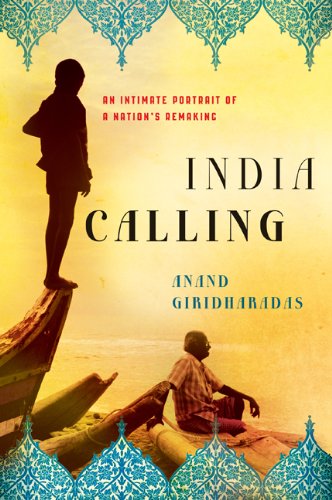
Anand Giridharadas (AG) can, and it’s not just because of his kickass mountain-scape-like, 5-syllable last name (that I’m sure gives him sharp eyesight and keen hearing). A journalist for the New York Times and International Herald Tribune, he spent 4.5 years living in and reporting on India, and returned to the United States in 2009, where he continues to transcribe the Subcontinent’s rumblings. His book, INDIA CALLING: An Intimate Portrait of a Nation’s Remaking, was published by Times Books last week, and he is touring North America publicizing it, armed with books to sign, spiffy blazers, a microphone and refined ideas about India.

The evening starts with an excerpt from AG’s book which he reads easily, stretched comfortably in his chair. He selects an excerpt about the Dube joint family where cousins grow up as siblings and adults are parents, aunts and uncles at the same time. The “noisy, overwhelming love” that such families cultivate in small spaces is that unmistakable trait of Indian families, the “ambient love…unlike the kind that I had grown up with,” AG tells us. This is a traditional family where sagacity comes experience: “old always has the upper hand; new always stands on the defensive.” The providers in the family are “Upstairs Chacha” (uncle) and “Downstairs Chacha”—childhood brothers—who live, appropriately, in the upstairs and downstairs sections of the house.

Over time, AG observes the “family Marxism” morph into separate households each Chacha has “cleaved” for his family. “A rupture was torn,” AG writes, which manifests in the house’s physical upkeep, the parents’ ambitions for the children and the methodical expansions of parts of the house. “Money makes a man perfect,” Upstairs Chacha explains to AG, which used to “come from love” but no more. Recognizing this, Upstairs Chacha reconfigures his priorities while Downstairs Chacha enjoys the complacent pace of life, the conversations “filled with banalities and gossip.” Upstairs, time is to be seized; downstairs, it is to be endured. Which is right?

After a 15-minute reading, Aseem Chhabra moderates a discussion with AG, opening with a reference to Slumdog Millionaire and the can-do attitude creeping over India’s farthest corners like a fat monsoon cloud. Specifically, can AG tell us about one particular character who really made an impact on him?

Most of the books characters represent a “sliver” of India’s bulging populace, but if there is one person who “stands for the transformation in India,” it would be Ravindra Misal from Umred, an unexceptional town in Maharashtra, who climbed up in a world that “no one sensibly would think anyone could get out of.” He has developed a new genre of entrepreneurship, stemming from the “great epiphany” that he is not alone in wanting to do more, be more, receive more. AG finds it a “fascinating and complicated question” when a child of squalor wakes up and declares, ‘I will not become like my parents.’ It is can-do in its rawest form. Misal leaves the classroom after surrendering to an unforgiving exam system, picks up a series vocational skills and returns as a teacher—a triumph of karma? Realizing that he can channel hope and dreams into the town’s youth, Misal creates an English Academy and organizes roller skating classes.

Chhabra interrupts with a smile. Roller skating?

To people who come from such poor, rural backgrounds, “simple, meritocratic competition appeals” the most, AG explains, so the idea is that cheap “two by two” roller skates are sufficient to create a game and enliven an entire town.

It is a matter of time before the roller skating amateurs turn into pros competing in international competitions. Gregarious, talkative Misal—India’s roller skating team manager—is unusually tacit on the plane to Hong Kong, where he “just kept his camera on the window, pointed down at the farmland” he was leaving behind. AG pauses and we reflect with Misal about how far he has come, and how different home looks from so high up.

Chhabra describes the typical, and now more frequent, Indian story of the poor villager traveling to a city, his success culminating in a house, employment and an upgraded dignity: the ol’ rags to riches tale.

“I think the reason I like [Misal’s] story is because he didn’t reach a Bombay or a Delhi,” AG says. He believes that the “story of modern India” is a million “incremental bumps up” rather than a stampede to Bombay or Delhi, cities which are rapidly reaching critical mass, as the New York Times reported last November. Success comes from the more inherent acknowledgement of “personhood,” recognizing that you are a person, a body of potential that ought to be tapped.

Chhabra connects this new sense of independence to India’s economic liberalization. Does AG agree?

Not quite. Not all of India’s development should be attributed to India’s new economics or the “gust of capitalism.” Sure, “capitalism is a contributor,” but AG sees something larger: the mind shift from society being God-made to being manmade. He quotes Dr. Reddy, Governor of the Reserve Bank of India from 2003 to 2008, who praised the marriage of economic empowerment and social empowerment that enabled millions of Indians to recognize that “they are people.” The term ‘emerging market’ is “such a reduction,” AG continues. You can’t tell one billion people with millennia of history that they amount to an emerging market. Look at Russia and China; they have had and continue to show extraordinary growth; but do they have the same “people dynamism” as India does? Finding their voices, Indians are evolving from a culture of “paupers and maharajas” to a culture of “middleness” – it’s the middle class who are shaping new developments, championing causes, and demanding change.

Chhabra asks about angry reactions from NRIs that AG has faced in response to articles about India’s less uplifting statistics: high farmer suicide rates, ultra-poverty and gaping corruption, to name a few.

AG shrugs. “It makes your blood curdle driving through India even if people in big houses don’t want to read about it in the New York Times.”

Does AG want to comment on the “monstrosity” of Mukesh Ambani’s billion dollar home?

Another dismissal. “I don’t care… He spends a lot less on housing than you or I do…I’d rather he also create an AIDS foundation…I don’t begrudge him for what he does.” AG points out that an Ambani endowment could be the next world-changing foundation. “It’s not the Gates Foundation; it could be.”

Chhabra tries another angle: having returned from India, is there anything AG reflects on from his time there that saddens him?

AG returns to Misal’s incredible story. It’s “so striking what these kids learn,” he says; they are so “hungry to get ahead.” Misal is imparting concepts like SWOT (a strategic planning tool, popular in consulting-speak, which stands for ‘Strengths, Weaknesses, Opportunities and Threats’) to 16-year olds; most Americans don’t encounter it until their first job in their early twenties. AG observes some of Misal’s classes and sees that, in teaching these eager adolescents how to speak, you are trimming what they think about, focusing on ambition and independence. “They are being trained, not necessarily educated,” he says, which means there is no priority to learn “Tagore, Ashoka, Kabir.” India has 5,000 years of history but that is being put aside, and “that’s what worries me.”

AG turns to the audience: students at Columbia’s Journalism School have made a choice not to go into investment banking but instead to “make less and make a difference,” which is a culture that has not yet come to India. Right now there is “ambition and private dynamism,” but what about collective endeavors, what are the “social tradeoffs?” He reminds us that “just making money won’t bear out.”

Chhabra opens the discussion to the audience for questions.

Q: Is the ongoing psychological revolution—this new-found sense of opportunity and entitlement—creating a culture of evils, inciting more clashes between the old and young?

A: You can draw a million lines in India—upper/lower caste, upper/lower class, rich/poor—but the most important is young/old, since they span the psychological rift spreading over the nation. America went through this evolution of thinking over 150 years and India’s now cramming it into 20 years in an “orgy of development” where “churn is the only kind of change.” That is a “very bitter truth” for an older person to reconcile with, given that he cannot adapt as quickly. Whether he is rich or poor, the old man is resentful because his plans and dreams no longer apply; the rules, the landscape, his world, have changed.

Q: Has Ravindra Misal’s story and success spread to other villages, are others adopting his ideas?

A: Only a few people know his complete story the way Giridharadas has chronicled it; one or two are aware of his success. However, he is the “ambassador of escape,” the “most respected young person in that town,” which is a strong currency in India. “There is a change in the hierarchy of respectability,” demonstrated in Umred both dangerously and comically: During a motorcycle joy ride—Misal driving, Giridharadas behind him—they were stopped every few minutes by townspeople eager to greet their village hero. They wished him with folded palms—namaskar—which Misal happily returned with his own palms folded, casually taking his hands off the motorcycle and giving Ghiridharadas several heart attacks!

Q: Is there any disapproval by the youth to India’s rising growth and consumerist attitude?

A: It’s too soon for such a reaction to manifest. The current young generations see their future in this growth; it’s too early to tell. Consumerism isn’t all bad, after all. A “consumer-based pecking order” is a “lot less stupid” than doling out respect and opportunity based on one’s great-great-great-great grandfather’s profession. Money can be the “gush” to break up such thoughts of caste-driven respect, and it “needs time to do its work.”

Q: Do India’s elderly show dissatisfaction with India’s goal of modernization because they didn’t have that freedom or chance to do what their progeny are doing now?

A: Absolutely. Today’s elderly are in a sad state of limbo and can still remember being restricted in their youth, something their children and grandchildren are no longer stymied by.

AG’s grandmother lived through this. At first, she said she was thinking the ‘wrong thoughts’ by seeking more in life beyond her role as a woman/wife/mother/daughter-in-law. So she stopped vocalizing them. Then she just stopped having thoughts: “I just realized that I wasn’t supposed to talk.” Today, however, she is the head of an NGO working in the slums. Similarly, and on an inspiringly large scale, people from tiny villages in rural India passionately express their opinions in response to an AG article, because they finally feel that sense of entitlement, that they matter, that their voice ought to be heard. History, politics and culture did a bad job instilling a land teeming with people with the notion that they have a legitimacy to assert, and the tides are slowly reversing.

Q: You were recently in China, have you written about the India/China contrasts in their approach to the 21st century?

A: Yes, an essay called ‘Chinese Dreams’ that was published in the Antioch Review. The key difference is that the Chinese realize that they’re on the verge of becoming a “big stinking economy”…with no personality. China “wiped out everything”—Confucius, Mao—to get to where it got. “India didn’t do that. Wisely.” India’s a little soulless, but not as bad. If anything, AG adds, it’s a “little frustrating how often the past wins.”

Q: How is India’s youth reacting to the environmental risks of such aggressive development?

A: It’s a “really, really tough issue.” Two-thirds of India lives in villages, most of which are yet to enter consumer culture, so it’s hard to tell them to stop when they haven’t yet started. A villager brings home his first electric lamp, and you want to tell him to cut back? After watching An Inconvenient Truth, AG’s young Indian friends reacted with, “Man, America really needs to do something.” It’s not yet (the bulk of) India’s responsibility or prerogative; they aren’t there yet.

If one follows the Western road to modernism—summed up by AG as rural to urban; clan-based to independence-based; women’s rights; and so on—you can see how things end: marriages don’t last and the environment starts to crumble. The question is, can we liberate women and not get stuck with a 50% divorce rate, or give 100% of India electricity without increasing pollution? Is it possible to pick the positives without the good-and-bad “prix fixe” of Western development?

Q: How can we reconcile all this development with the boss of indigenous knowledge (native languages, etc.)?

A: Misal, for example, is neither a master of English, Hindi nor Marathi. Hillary Clinton and William Dalrymple describe India as a nation of “linguistic half-castes.” But is that so bad? AG dismisses this as the “transitional stuff of a country figuring itself out.” He’s less comfortable with the 48% child malnourishment rate.

Q: Aren’t Indians in India still figuring out who they are relative to Western societies?

A: AG responds two ways, both heralding promise. “The happiest thing that I’ve found,” he starts, and “the most important drama of Modern India” is the “erosion of that inferiority complex.” No longer feeling the effects of the “old colonial hangover,” Indians are “falling back in love with themselves”.

He presents a couple examples:

  • Speaking with a strong Indian accent no longer precludes someone from being part of the “bona fide Indian elite,” a la Mukesh Ambani.
  • Indian advertisements in the 1920s and 30s were inaccessible to the majority of the country. Their slogans read, “…pause that refreshes:” definitely indecipherable to non-English speakers. Fast forward to the past decade; Dominos in India tempts customers with “hungry kya?”

Today’s thinking is: address the masses and their responses will resound. Send a text message—I mean an SMS—in that ghastly text-speak “u r 2 sweet 2 b 4 got 10’, comment on the news with poor English, create English Academies that teach catch phrases and corporate jargon, it doesn’t matter; your voice will be heard. The new is on the offensive.

It’s “such a profound revolution,” AG enthuses, and remembers a recently returned-to-India friend’s description of India: “it’s like a big dance party!”

India is calling, and this is one call you don’t want to miss.

Watch AG's INK by TED talk here: http://anand.ly/in-the-news/five-ideas

Read The Indian Express' miffed and witty opinion on the book here: http://www.indianexpress.com/news/anything-to-declare-at-immigration/751914/0.

Saturday, December 18, 2010

Adopt a village in Tamil Nadu for just $500; help kids learn to read!

Balaji Sampath speaks at Princeton University about AID’s revolutionary Eureka SuperKidz Initiative

My Plea

Tamil Nadu has one of the lowest child literacy rates in India. As of 2002, schools boast an enrollment rate of 99.5% (and that number has increased since then), but over 80% of 5th standard students can’t read. What does that say about the state’s education system?

Plenty, if you’re Mr. Balaji Sampath, Founder and CEO of the Association for India’s Development (AID), which has been working with the Indian government to revolutionize the way students are taught basic language and math skills. He believes in “education, health and livelihood:”

  • set clear and simple goals for the students
  • cultivate a healthy environment for learning
  • translate parents’ livelihoods (however small) into teacher accountability

On December 18th, he showed us with slides, handouts, chalk and a blackboard how AID is implementing these principles today. Read his story below, and if you’re inspired, donate to his project, Eureka SuperKidz by December 31 for your donation to be matched by generous donors. I believe I have enough family and friends to adopt a chunk of the 88 villages left, and I hope you will help me in this worthy campaign!

Sampath’s Story

Kerala and Himachal Pradesh have the highest children literacy rate, while Tamil Nadu, Bihar and Uttar Pradesh rank at the very bottom. “Learning was just not happening,” Sampath says matter-of-factly, the preface to his 15-year-long story about AID’s introduction to and involvement with Tamil Nadu’s rural poor.

In 1994, the World Bank launched the District Primary Education Program (DPEP) in India, in parallel with AID’s surveys and assessments. “No organization works in a vacuum,” Sampath says, and explained some of the crucial realizations the collaboration yielded:

  • While student enrollment—that is reported on—is high, so are dropout rates. Angry, frustrated and embarrassed parents pull children out of school as early as the 3rd standard when they find out their children are performing poorly, or failing, and the child has slim chances of returning to school.
  • The Tamil Nadu government, eager to maintain high school attendance rates, instituted an “all pass” through 5th standard policy, uniformly passing all students regardless of their performance. Parents didn’t know any better and the students continued in school and continued not learning.
  • Re-evaluations at the end of the 5th standard showed similarly low literacy rates, so the government remedied the problem with an “all pass” policy through the 8th standard. It was a “short-sighted” solution, Sampath says, and created a “brain drain” situation from primary school onwards.

Partnering with Pratham, the largest education NGO in the world, in 2004, AID took a sample survey of schools across Tamil Nadu to see how the government’s new policies were faring. The results weren’t promising. With more funding and attention in 2005, AID surveyed every district in Tamil Nadu and Bihar and found approximately 53% illiteracy among school-going children. But the infrastructure seems to be in place; Sampath tells us that every school has 2 teachers for a classroom of 80 students spanning 1st through 5th standard, so how can the quality of learning be improved?

“If you make it fun, kids learn better,” Sampath says with a smile on his face. “When subtraction becomes a game that you play with 4 friends, you want to play it, and you end up learning.”

He demonstrates on the blackboard, drawing 8 Tamil characters with chalk. He rapidly explains them to us, “this is ma, pa, tha, ka,” and erases them as quickly. He draws just one character: which one is this? The non-Tamil readers/writers in the room (including me) identify them with some accuracy, mixing up ka with tha, but not ka with pa. Sampath’s point is that it’s easier to mix up letters, objects, numbers—anything—that look similar, such as ka and tha, or, switching to English: b, d, p and q. “It’s easy to see that a and b look different; one has a stick attached to it. So how do you tell the difference between b and d, that both have sticks and balls?”

Make it fun! The more fun a task, the more appealing and the less difficult or cumbersome it becomes to children. He shows us a math jigsaw puzzle, 9 individual number squares that make up a 9x9 box. Each tile has 4 numbers on all 4 edges, written as arithmetic problems (4+15; 13x2) instead of the answers (16; 26), and the objective is to piece the puzzle together by matching the numbers on the edges of each tile with the 8 other tiles in the puzzle. It’s a basic game, made out of paper and requires a lot of arithmetic to play and complete. “Our resources are limited to paper, cardboard, markers, so we keep our games simple,” Sampath says.

Games are effective because kids work together, challenge each other, and learn in the process. “Attention span increases, focus increases.” Voila: a learning environment.

Next, AID introduced their learning-through-games methodology in 2 schools in Tamil Nadu which quickly showed positive results. They talked to the government about expanding the program, which seemed skeptical at first. But a government assessment in 2005 showed that AID was right, 5th standard students really could not read. Frantic, they demanded state-wide intervention from AID, who responded with a plan to work in 5, then 10, then 15 districts, scaling up the program over time. AID has created the 6th standard text book for schools all over Tamil Nadu. Sampath switches to the next slide in his presentation, showing us impressive quantitative results:

  • The government funded teacher training in 7,300 schools
  • Pratham funded reading campaign in 13,000 villages
  • UK-based Children’s Investment Fund Foundation (CIFF) provided monitoring in 7,219 schools

“The goal is not to improve education as a whole but, more simply, to teach kids how to read,” Sampath reminds us, reiterating the need to keep targets simple.

AID sustained a 3-year continuous focus on 10 districts, reaching 1 million kids, training 18,000 teachers and running AID-designed classroom lessons for 1 hour a day in the classrooms of all 10 districts. As important as exposing the children to these creative learning incentives and techniques, was exposing the teachers to the reality of their students’ abilities. The AID assessment showed the teachers that more students than they thought could in fact not read.

The response to this glaring gap in the children’s education was straightforward: set a goal that all students will be able to read sentences. Simple goals and strategies are far more effective than complex ones when working with 18,000 teachers. “Take the example of India’s freedom struggle,” Sampath reminds us, “make salt. You can’t get simpler than that!”

Draw up two lists: students who can read and students who can’t, and work with the students in the latter list to move them to the former. Leverage kids who can read, have them help those who can’t. Involve the students because “you can’t hide things from children,” Sampath laughs, and simple goals appeal to kids. “They have an incentive to move lists. They set goals for themselves. If I read a sentence will I get a certificate? Will I move to the other list? Ok, I’ll do this.” Sampath assures us that sentences are picked at random when testing the students’ reading ability to ensure they actually can read and have not just “mugged up” a passage.

Percentage marks in an assessment doesn’t show students what they have learned and not learned; it is unclear what they have to improve upon to move from 60% to 80%. Tell the kid what is to be learned—a to read a sentence, a paragraph, 2-digit subtraction, etc.—and the students can go about it more effectively.

AID’s assessment highlighted another glitch in children’s education. Most of the children who could not read had parents who were illiterate and not involved in their children’s schooling, and could not provide any homework or other after-school support. Typically being from lower communities, they did not feel confident to approach or confront teachers—literate, better paid, higher status— with concerns about their children. “Getting the parents involved matters as much as, if not more than, game learning and regular assessments,” Sampath concludes.

He paints a picture for us: a classroom in rural Tamil Nadu today holds 80 students spanning 1st to 5th standard, with2 teachers attending to the entire group. Obviously, this makes individual attention very difficult, if not impossible. How can this be addressed?

Eureka SuperKidz!

Sampath describes how AID visited several villages and appointed 3 “young people” as after-school teachers trained by AID. Each is paid $1,000 / month, which is split between AID (Rs. 500) and the village, who further divide the fees between all the parents, so each family contributes Rs. 25. The afterschool program runs from 5 p.m. – 8 p.m. daily and leverages materials (assessments, workbooks, games) supplied by AID.

Such materials show the village that AID takes literacy and after-school programs extremely seriously, exciting the parents to be equally engaged. Now everyone is working towards the children’s development. More importantly, perhaps, is the approach that the after-school teachers take, which is to move away from the “I teach” attitude to the “you learn” attitude. Progress is measured by output from the children versus input from teachers. The teacher’s agenda isn’t to push material onto the students, but to pull learning out of them. A simple attitude shift, but so critical!

Sampath reads out names from a visual check-mark chart showing students’ progress afterschool, in fundamental concepts in English, Tamil, Math(s) and Science). “Janet has learned 2-digit subtraction; Monisha has learned 2-digit addition but not subtraction; Armstrong has also learned multiplication…by the way, names in Tamil Nadu have changed quite a lot!” he jokes. “We have a lot of Stalins and Marx also!”

A mentality shift is taking place: take the example of microcredit. Poor women thought themselves separate from banks, in no way connected to them or reliant upon them. After international organizations and NGOs set up microcredit programs, bringing women together, having them meet regularly—very important, we learn— the women recognized that they were making the effort, saving money, maintaining personal accounts informally , and believed that the bank did owe them something. A new market was created.

Similarly, teacher/parent reciprocity and accountability is very important. The after-school teachers in the villages are from those villages, locals that the elders have seen grow up, so even if the parents are illiterate, they do not feel inferior to these teachers. They are confident enough to confer with them regarding their children, since they, like any parent, want the best for their children. The students feel the benefit of the encouraging educational environment they’re in after school, at home and with their friends, and are motivated to excel.

In Bihar, the same after-school program is in place, running earlier in the day, from 2 p.m. to 5 p.m. since it gets dark quicker. “Some villages have solar lights for our programs; that’s the only part of the village with lights in the evenings,” Sampath says.

Now What? The Perfect New Year’s Resolution!

Here’s where we come in as interested donors, inspired individuals, locals, NRIs and firangis with networks of family and friends who believe in education. AID has identified a group of generous donors—Prithvi Solutions, Prabhu, Shiva, AGK and SAVLAC Fund—who have put together a Seed Fund to support the Eureka SuperKidz project in 250 villages in Tamil Nadu. A village costs $1,000 to adopt so we need to provide just $500 per village. You can do so here: please include my name and ‘Dec 18 Princeton University talk’ in the Comments section. Donate as individuals, families, student groups or however you choose, the money’s going directly to Sampath and the villages!

Hopefully these folks will nudge you in the right direction:

  • A UChicago MBA student is providing additional funds to sponsor students who complete school to attend college.
  • Mohana, a 7th standard girl in one of the villages, called “makku” by her friends and deemed an expense to her drunkard father, sells her dad’s liquor bottles to pay the Rs.25 teacher fee.

Still Not Convinced? Maybe the Internet can Help

Kirsten Anderson worked with Sampath for 2 years in Madras as an American India Fellow (an AIF peer of my dear friend Hamsa Subramaniam) designing an English reading curriculum, and helped produce this video about AIDs efforts in Madras: http://www.youtube.com/watch?v=nRSPg-fy02w&feature=related

And on a lighter note, here are some of the outtakes: http://www.youtube.com/watch?v=2sv_8iDXdsM

Charles Leadbeater, an expert in “innovation strategy,” gave a superb TED talk on different and creative ways to educate the children in burgeoning cities in the developing world. Like Sampath, he believes in the “push, not pull” approach; it’s not what the teachers teach, but what the children learn, and he praises Pratham’s creater Madhav Chavan highly. Watch the TED talk here, it’s just 20 minutes: http://www.ted.com/talks/charles_leadbeater_on_education.html

For even more inspiration, here’s what kids all over India are doing to effect social change in India, an idea discussed by educator Kiran Bir Sethi in another TED talk: http://www.ted.com/talks/kiran_bir_sethi_teaches_kids_to_take_charge.html

If you don’t want to donate to this cause, check out some other organizations featured by the New York Times: http://www.nytimes.com/2010/12/19/opinion/19kristof.html?_r=1&src=me&ref=homepage.

If you made it all the way to the end, thanks for reading, watching and, hopefully, donating!

Wednesday, December 15, 2010

20 (Writers) Under 40 (Years) in 80 (Minutes): Authors selected as The New Yorker’s best 20 UNDER 40 speak at the 92Y Tribeca

It’s always satisfying to put a name to face, and even more so to put a voice to a face. Deborah Treisman is the Fiction Editor of The New Yorker magazine, and interviews writers and holds consistently eloquent discussions about writing on her weekly podcasts. Today she is stylish in a grey dress and shiny red leather boots that I now want (I’m a sucker for red). Thank you all for coming in spite of the cold, she greets us, “I probably wouldn’t have made it out.”

But she is clearly happy to be here and glows like a proud parent about the provocatively ambitious list of authors she and fellow editors conceived, whose gestation period involved expansions (so many authors to consider!) and contractions (so little time!), and which eventually birthed a brilliant collection of stories. It was “exhausting and thrilling,” she says, and she’s overjoyed at the result, to have all the stories “united” in one issue. She is standing at the podium on stage with a hemisphere of empty chairs behind her. “These aren’t for Chinese dissidents,” she cracks, but for the writers to occupy after their readings, when the audience can ask questions. Without further ado, the writers begin.

First up is David Bezmozgis: tall, dark-framed glasses, tame in a sweater and collared shirt. Treisman describes his writing—primarily about immigration, culture shock and identity— as “politically savvy and emotionally deft.” Bizmousis reads a section of THE TRAIN OF THEIR DEPARTURE, dealing with a romance between a male and female protagonist. The thorn here is a pregnancy and a perplexed is-he-or-isn’t-he father, who thinks of babies as being “the size and vascular transparence of a gooseberry,” floating around in the “red convection of the womb.” The weary maybe-maybe-not father reflects that “life, which he treated as a pastime, which he thought he could outdistance, had caught up with him.”

Second is Nell Freudenberger, praised in an article following her first book as being “too young, too pretty and successful.” With a bashful smile and a calm monotone she reads from her story AN ARRANGED MARRIAGE, which came to her after a chance conversation with a stranger on a Jet Blue flight, an involved email correspondence, and an internal compass directing her towards a plot. Amina is soon to be married to George who she met and is getting to know over email. When she first sees a photo of him she observes his “large uncolonized expanses of cheek, nose and chin,” which she later decides she can love. Her parents debate hiring a rickshaw to bring the visiting fiancé from the main road to their house, about 200 ft of unpaved path away, but decide that such a gesture would be “more of a spectacle than it was worth,” and I am struck by what the ‘spectacle’ of an arranged marriage conveys to readers both familiar and foreign to the concept. Amina wonders what George looks like and her mother—who met and married Amina’s father of her own accord, via a ‘love marriage’—placidly reassures her that he looks the same as he does in his photo: “nothing is wrong,” and I wonder if it's ironic or intended that I think of the prevailing American sentiment that we are innocent until proven guilty. Before Amina moves to Washington, DC to be with her fiancé, her mother exacts a promise from her not to do “that” before they are officially married. Amina is emboldened by the intimacy of proximity and inevitable propinquity, and breaks her promise to her mother. While she does not like his facial expressions while he’s on top of her—“as if he were in pain somewhere very far away”—she has no regrets the next morning, a significant marker of who she is and who she is becoming.

Third is Rivka Galchen who, Treisman says, draws from a “closet of curiosities” and a “grab bag of interests,” a sort of “Thomas Pinchen meets Kafka meets Oliver Sacks” for the scientific, technical and colloquial happenings she writes about. Galchen reads from THE ENTIRE NORTHERN SIDE WAS COVERED WITH FIRE that begins with a bit about the dearth of readers these days being a “felicitous injustice.” Galchen is expressive and performs her story with expression, comedic hesitations and flawless timing. Her hair is tied in a ponytail that looks like it was an afterthought, but is actually skillfully done, much like her writing, which reads like a casual conversation because of how finely it is crafted. The main character, Trisha, is in the middle of being pregnant, left by her husband, lectured by her brother and tempted by filmmakers, and Galchen manages to bring into context romances between land animals, Parmesan cheese graters without the “unappealing ‘comfort’ grips” and money being “also very winged.” She is hilarious and poignant!

Fourth is Karen Russell, the shortest and most cherubic of the bunch. She writes about things that are “both singular and universal,” Treisman tells us, and whose “cultural references are sweeping.” Russell sweetly thanks Treisman. “It’s great to be here with this rad team,” she says, drawing a chuckle from the audience. Her story is THE DREDGEMAN’S REVELATION and the main character is someone who works on a dredge for so many hours a day that “lately he preferred to think of himself as a profession.” Russell’s voice is soft and airy, musical and sounds practiced; I could listen to her read for a long time. She smiles when her main character starts reminiscing and “trying like the other guys to turn his life into theater.” She boldly uses Southern and Turkish accents for other characters, making us laugh again. After a traumatizing delivery that leaves a baby near-dead and its mother dead (prompting its adoptive father to later repeat like a chant, “you were born dead,”) the audience is as grateful as Russell that the baby chose life: that “windy interval between birth and death.”

Fifth is the one author I recognize because of his distinctively receding hairline, dark hair and perpetual boyish grin on his face. Gary Shteyngart manages to be “hilarious and heartbreaking at the same time,” per Treisman, and effortlessly applies his “well developed satirical skills” in his writing. His 3-line biography includes the sentence, “Gary Shteyngart lives in his own head” and Treisman invites us to visit it with her. His opening line to the audience is, “I can’t believe I’m not 40 yet! I feel like I’m 80! Jeez!” with mock truculence. He reads from SUPER SAD TRUE LOVE STORY which is set in the future and where everyone’s quirks are magnified. There’s the group of scientists that is “trying to find a cure for death,”—Shteyngart starts laughing, heh heh heh—“not going so well.” There’s the protagonist’s mother who welcomes him home with “some Russian garbles of amazement” and uses her “post retirement English” when addressing his non-Russian, non-Jewish (the latter a reason to disapprove) girlfriend. Shteyngart mimics with his hand the action of the mother running her hands through her son’s hair and describes how she quickly covers the couch before her son sits on it, since he’s wearing “compromised Manhattan outerwear.” There’s the father who, when he hugs his son, leaves behind some of the “grey carpet of hair that my father wore with a touch of class.” When he pulls his son into the living room for a father-to-son talk, they discuss “all the monetary things that kept us fearful and connected.” Shteyngart hops nimbly between the narrator’s American accent, his girlfriend’s question-mark-at-the-end-of-every-sentence American accent and his parents’ eager, affectionate, thick Russian accents. The novel may be super sad, but this bit is pretty damn funny.

Sixth is the author with the coolest name: Wells Tower (who names their kid Wells?). Treisman says of Tower that he captures the “panoramic cavalcade of American life” and has a “cinematic eye for the details that both stab and tickle.” Tower reads smoothly from THE LANDLORD about a real estate “investor guy” going through some “stuff” whose 31-year old daughter, Rhoda, creator of uniquely incomprehensible yet message-driven art, moves in with him unannounced, and continues to stump him with her work. “Her field is bummers,” the father tells us, since Rhoda makes “leukemia-cluster art, floating-yuan art, water-rights art, and mental-health-funding-cuts art,” among others. When Rhoda speaks, Towers impressively executes her waterfall of dissent, disdain and disgruntlement with rapid-fire diatribes about the recession and her ex-boyfriend and her father’s porn collection and that creature from the ‘Black Lagoon’ movie they saw together when she was 8. Her father convinces her to go out for dinner one night, and drives her through the scenic route—how about a sunset for message-driven art— made more beautiful by Towers’ light, rhythmic alliteration: in the “late light” of sunset, “each blade [of grass] looks hand-tinted;” sneezeweeds “dot the ditches” and are “woozy with the weight” of their heads. Writer Gary Lutz, known for his essay ‘The Sentence is a Lonely Place,’ would be proud. Rhoda complains of a “massive Old Testament magnitude of guilt” from her childhood, and confirms that being exposed to “a walking compound genital” in ‘Black Lagoon’ didn’t help. What would? Seeing “a Pegasus fucking a unicorn.” Good to know!

After being read to about porn, arranged marriage, cheese graters, Turkish doctors and abortions, we are primed to ask the writers questions. They arrange themselves on the stage and finger their microphones with varying levels of awkwardness and habit.

Books versus electronic media? Shteyngart responds that reading a book means “completely shutting myself off, which you can’t do with an electronic device.” Booya.

How should an audience member write her autobiography? Russell offers friendly advice: “act like a tennis shoe” (and just do it!).

How do these writers deal with rejection, and what does it mean to have been elected to this prestigious list? Bezmozgis responds: “the nature of the job is rejection, it continues,” and urges people to keep at their work regardless of how tiring or obstacled it seems.

Do any of them teach writing or English classes, and why? Russell enthuses about how fun it is to “get to read closely” other people’s work, especially younger people who are “free.” “You have to wear pants in a room; that’s always good,” she adds. Hmm...

Do they find themselves being more subversive than usual in their stories, to pack a stronger punch? Towers says, “I vent a lot of bile and sorrow on the state of American politics” in non-fiction magazine pieces, but fiction is a space “where I can intrigue myself” and explore the “more fundamental artifacts of human emotion.”

A question to Treisman reveals that this same list from 11 years ago recognized 15 men and 5 women, and this year has yielded 10 of each. Hurrah!

How can first-time writers find their voice? Shteyngart says that reading aloud helps activate the “bullshit meter.” “There’s kind of a shame to reading in front of the mirror, but it’s helpful…do it naked if you have to.”

Sounds like a plan. Although, maybe I’ll keep those tennis shoes on.

PostScript: I haven't read any of these stories in full yet, but based on what I heard tonight, here's how I'd rank them:

1. Towers

2. Galchen

3. Russell

4. Shteyngart

5. Freudenberger

6. Bezmozgis

You?