Showing posts with label travel. Show all posts

Wednesday, October 6, 2010

Safarewell

[Manyara National Park --> Ngorongoro Crater National Park --> Arusha]

Sunrise on the hills of Manyara is like no other. The hills glow red before the glow of the sun comes into view.

The morning improves with a hearty breakfast, then we’re off to Ngorongoro Crater after thanking our chef for the safari, Dickson, for his enjoyable meals.

Since Ngorongoro is a crater, we drive up up up to top at first, and then still more up up up to the crater entry gate. We pass Maasai laborers on our way, gathering fruit, wood, working. Then we head down down down into the crater where animals aplenty wait.

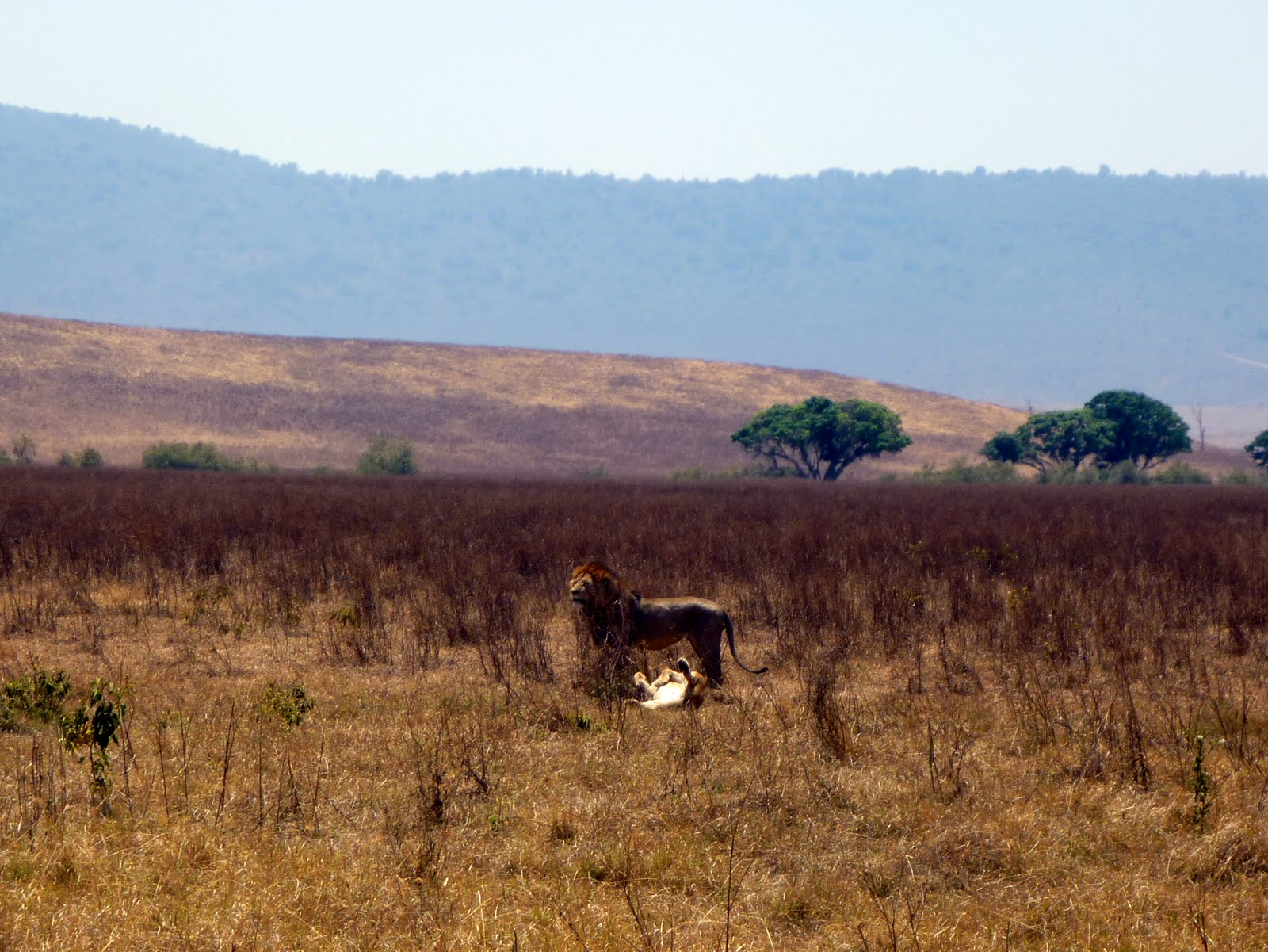
A queue of jeeps announces a male and female lion “on honeymoon.” If we wait “12 to 20 minutes,” we may see them “make love”. The most we get is some stretching, she rolls over, he licks her for a while. Not as exciting as we’d hoped. Still, when he stands up, he is intimidatingly tall and large!

The zebra and wildebeest are much more used to humans here than in Manyara, and don’t dart out of the way when our jeep approaches. We take advantage of the close ups for better photos and more involved observation. [Enjoy some terrific wildlife footage by a dedicated South African couple who befriend a leopard, drown $2 million worth of camera gear and film a pride of lionesses attacking an elephant here: http://www.ted.com/talks/beverly_dereck_joubert_life_lessons_from_big_cats.html.]

Lunch is at a lake where all the other safari goers have gathered to eat, like a herd of wildebeest grazing in the shade, close to the water; good thing we aren’t anyone’s prey. Hippos bask in one corner, a few surface and submerge near us. I eat my hardboiled egg and remember cracking a similar egg at Mawenzi Peak just a few days ago.

It’s hard to fight sleep after an early morning and so much food. We don’t have to do anything besides sit and look, which is also conducive to a snooze! I wrap Hamsa’s kanga tighter around me to keep the cold air from making the hair on my sunburned arms stand on end. Amazing how cold it is down in the crater!

Walter nudges me awake as we ascend the crater on our way out. Still no faru, or rhino—the last of the ‘big five’ animals to spot—and we take in the rainforest views for the last time. We get to the Ngorongoro gate where Dickson and a van driver are waiting. Walter and I transfer our bags to the van, say kwa heri to John and we head for Arusha. We pick up 4 other passengers along the way—Dickson is comfortably sandwiched between driver and a passenger and they heatedly debate which of the 2 reigning political parties, CCM and Chadema, should win the upcoming elections. ‘Salaam Maria,’ a radio show, Walter and I gather, comes on the radio which quiets them down; in time for a flaming sunset, even. Walter and I talk culture differences between Americans, Europeans and Indians. I learn that Gouda (as in the cheese) is pronounced “howda.”

Back in Arusha, I am reunited with my Tanzanian family. Katana’s mother has had our hiking shoes washed! They are no longer mud-and-dirt splattered from climbing a mountain. “It is a mother’s work,” she says simply. And next morning, as I gather my things for the bus back to Dar Es Salaam and bid farewell to my new-found family, she is equally sincere and says what all of us are feeling: “it is very hard to say goodbye.”

Tuesday, October 5, 2010

Go Placidly Among the Animals

[Tarangire National Park -->Manyara National Park]

We’re up by 6 a.m., in time for a spectacular sunrise, delicious breakfast, and more fun in Tarangire. It’s quiet and empty and then—lionesses, 3 of them, 10 feet away from us! First we spot one twitching ear, then a nose, then a terrific yawn and 3 brown blotches camouflaged in the grass turn into sleek, drowsy lions. They’re by a tree near the river, snoozing until their prey comes to the water for a drink. Later we see them get up, stalking the antelopes!

Our luck continues; driving through the park we see 2 cheetahs, unmistakable with that height and gait, walking along the river bank, making the zebras up ahead nervous.

The main performance today is by the tembo—the elephants—who arrive en masse at the river. They arrive in a line, spread out along the bank and the older elephants—mothers and grandmothers—methodically start digging for water since it’s tastier the deeper one digs, out of reach of antelope urine and other dirt. The babies entertain themselves, get in the way of their protectors and every now and then a frustrated mother bats her baby away from her freshly dug hole, while an indulging grandmother shares hers. We watch them for at least 45 minutes.

After lunch back at Zion Campsite, we leave Tarangire and drive to Manyara National Park, sampling red banana from a street seller along the way—sweet, cheap and delicious! The campsite is up a mountain and the drive is exhilarating. We scope out our sunrise spots.

Back in park land, we see hippo, an assortment of grazers—i.e. more punda nilima (zebra), wildebeest, and pumba—and birds chilling at the river. Baboons and other monkeys boldly pass by. The elephants are shy, the zebras confused when we get too close, and they stride and gallop away as we furiously snap pictures.

Manyara is lush, green, fragrant with flowers of the white Mango tree; the sign at the entrance was clearly onto something, which reads: "Remove nothing from the park except: Nourishment for the soul; Consolation for the heart; Inspiration for the mind."

The sun sets behind the mountain, we head back to the campsite. Before, during and after dinner, Walter and I embark on quite the conversation—Ramana Maharishi (“Purpose of this world is to transcend it.”), Eckhart Tolle (“I am not perfect, I am whole.”), the Bhagavad Gita, marriage, a definition of the soul, a collective mind 6-billion strong, alcohol, and time warps. I read him a poem I stumbled upon at the safari office in Arusha, Desiderata, posted below for your enjoyment:

Go placidly amid the noise and haste,
and remember what peace there may be in silence.

As far as possible without surrender
be on good terms with all persons.
Speak your truth quietly and clearly;
and listen to others,
even the dull and the ignorant;
they too have their story.
Avoid loud and aggressive persons,
they are vexatious to the spirit.

If you compare yourself with others,
you may become vain and bitter;
for always there will be greater and lesser persons than yourself.

Enjoy your achievements as well as your plans.
Keep interested in your own career, however humble;
it is a real possession in the changing fortunes of time.
Exercise caution in your business affairs;
for the world is full of trickery.
But let this not blind you to what virtue there is;
many persons strive for high ideals;
and everywhere life is full of heroism.

Be yourself.
Especially, do not feign affection.
Neither be cynical about love;
for in the face of all aridity and disenchantment
it is as perennial as the grass.

Take kindly the counsel of the years,
gracefully surrendering the things of youth.
Nurture strength of spirit to shield you in sudden misfortune.
But do not distress yourself with dark imaginings.
Many fears are born of fatigue and loneliness.

Beyond a wholesome discipline,
be gentle with yourself.
You are a child of the universe,
no less than the trees and the stars;
you have a right to be here.
And whether or not it is clear to you,
no doubt the universe is unfolding as it should.

Therefore be at peace with God,
whatever you conceive Him to be,
and whatever your labors and aspirations,
in the noisy confusion of life keep peace with your soul.

With all its sham, drudgery, and broken dreams,
it is still a beautiful world.
Be cheerful.
Strive to be happy.
PS: Happy Birthday, Aparna!

Monday, October 4, 2010

Leopards, Bows and Arrows

[Arusha -->Tarangire National Park]

"It's Kili time" no longer; it's safari time! I meet my safari driver and fellow safari-goers a few hours after I was told to be ready and waiting at their office—good thing I can kill time with Katana until they show up. The driver is John, a tall lean man with a permanent smile and an egg-shaped head. The others are Walter from Holland, and Dirk and Diana from Germany. We all speak English, which makes for fun conversation on the long drives to and inside the parks.

We munch on lunch in paper and plastic bags as we leave colorful Arusha for the dusty palette of the road to Tarangire. We drive past a Maasai market, Maasai bomas or villages, and cattle herders on the way; they are effortlessly natural in the landscape. It is discovered at a quick grocery store stop to pick up water that one of our jeep doors doesn’t open. After trying to fix it with the help of some eager-to-impress village boys, we give up. Walter and I climb out of the top of the jeep to get in and out for the rest of the safari.

Arriving at Zion campsite outside Tarangire National Park a couple hours later, I run into Kilimanjaro climbers Vincent and Felitcitas; quite the coincidence! We enjoy a brief rest and then we’re back in the jeep and headed into the park. Walter and I sit in the back, the roof is raised, and the wind and dust blow through us, it’s fantastic.

Our animal sightings that evening are encouraging: gazelle, impala, elephant, a lioness in shade of a tree, a leopard in a tree(for which much pointing through powerful binoculars is required), some vultures, tons of zebra and wildebeest, warthog who seem completely unaware and high rats scrambling in and out of tunnels on the sides of the hills. The baobab trees make the flat parks seem even more flat, compared to the jagged and pointy baobab branches. And when it’s time for the sun to set, everything turns a deep shade of red.

Over dinner that evening, back at the campsite, I learn some Swahili / Maasai from John, specifically, what the park names mean:

  • Tarangire: in Maasai, ngire is pumba (or warthog; remember Lion King?) and tara is river – this park has lots of water and lots of pumba!
  • Serengeti = endless, in Maasai
  • Manyara = a type of tree in Maasai
  • Ngorongoro = the sound of the bells the Maaasai used to chase out the Bague tribe from the area
  • Tuta o nanu kesho = we’ll meet tomorrow.

Post-dinner I’m too tired to keep my eyes open much longer. We retire to our tents for the night and in the clear stillness I can hear Shakira’s “Waka Waka” song playing from a nearby campsite. A security guard walks around the tents scattered through the campsite and bids us all goodnight. He’s armed with a bow and arrow. What?

(Guess I needn’t worry about being attacked by a stray kiboko [hippo] or restless hyena.)

Saturday, October 2, 2010

Kilima Njaro: Check

[Horombo Hut --> Mandara Hut --> Park Entrance --> Arusha]

We wake up leisurely, close to 8 a.m. The day yawns before us, hours of walking downhill, succumbing to gravity; what a luxury!

I take the time to observe vegetation stretching higher into the sky, eventually we are back in rainforest. Specks of color from flowers, massive tree trunks, and sound travels uncannily through foliate to alert us to waterfalls, birds and monkeys. We happen upon a cow!

We receive certificates, take our final photos, leave Kilimanjaro National Park with fond farewells.

Now that we’re back at ground level, all the mundane thoughts I left behind for more pristine air are back. But there’s one surprise left: we visit the Marangu Falls for a final shower of nature before taking long showers in Katana’s house to compensate for days of sponge baths. We eat hungrily and sleep deeply.

Mt. Kilimanjaro was a humbling, exhilarating test of endurance with some of the kindest strangers I've ever meet. Hosea belongs to the Chaga tribe and therefore speaks Chaga in addition to Swahili. In Chaga, Kilima Njaro means “our hills,” he explains. There are other translations of the mountain’s name, but I like this one the best.

Friday, October 1, 2010

Twende Part II - Like Cheerleaders on Steroids

[Uhuru Peak --> Kibo Hut --> Horombo Hut]

The walk from Uhuru Peak to Gilman’s Point is slow and surreal, and we stop for tea at Gilman’s Point, stretching out, pouring hot tea from flasks, sipping deliberately, sighing with happiness, joy, relief. Hamsa and I don’t want to use up too much breath so we gush to each other with our eyes; our guides watch on in amusement. The tea is over but we don’t want to get back up and start walking again, although we really should; it’s high time—no pun intended—that we descend from this absurd altitude. “Let’s get our twende on,” Hamsa says. Alright, I agree. Let’s do this.

Descending is double the fun in half the time, double the pace and half the pain, double the oxygen and half the snot, double the disbelief that we actually summitted and half the painstaking reality of marching ahead one step, one breath, at a time.

As Saint-Exupery writes, “nothing can match the treasure of common memories, of trials endured together, of quarrels and reconciliations and generous emotions,” and everyone we encounter on the climb down, back in Kibo Hut, and on the walk back to Horombo Hut we greet like long lost family and encourage like cheerleaders on steroids.

Walking near-vertically down the steep slope that we crawled up and cried over just that morning, we leave entrails of dust behind us as more rocky slope comes into view. I almost become frustrated at one point: where the hell’s Kibo, dammit? Why are we still walking? But I can’t complain; I’ve been lucky enough to reach the top with no complications, and I’m going to be grateful for each easy step I have to take to return to thicker ranges of oxygen.

After a brief stop at Kibo Hut for lunch and more hot tea, we continue onwards to Horombo Hut. I remember the view, having walked the same path the previous day, but it feels completely different now that I’ve touched heaven. I’m moved to sing—good thing I’m walking ahead of Hamsa and Katana, and well behind Hosea!

Walking on flat ground leaves room for reflection: there are so many words and there are also no words to describe what I’ve just done. Surrounded by so much nature, so much sky, so much openness, so much potential, so much air to breathe, so much of everything—where is the room for language? It’s just amazing to experience something this big, that you climb for days and days!

Twende Part I - Snot

[Kibo Hut --> Uhuru Peak]

[This post is dedicated to my brother, the king of snot.]

It's freezing. When we retired for the evening I hastily covered
myself with my sleeping bag instead of climbing into it, and now my few hours of attempted sleep are interrupted by irate toes and numb fingers; never mind that they are covered in layers of socks and gloves. My nap is fitful, but how are you supposed to sleep knowing that you are 1.5km shy of heaven?

At 11 p.m. footsteps crowd our already crowded room: our guides have come to wake us up. Slowly, lights are turned on, our day begins—in the dead of night—and it’s time to get dressed. I put on almost every article of clothing I have brought with me, as do Hamsa, Katana and our new friends. A Coloradan offers the Swiss woman pills for her headache; I share my cough drops with the group. We all met no more than 24 hours earlier, and 24 hours from now we will be going our separate ways, but for this window of time, we are smitten with the same love, feverish with the same excitement; we are summiting this mountain as family. As Saint-Exupery says about flying “you have reached an altitude where all loves are of the same stuff.”

My head lamp cuts through the thick blackness when I go outside to use the bathroom. Squatting over a hole to pee is tricky when I am so heavily bundled up! I return to the room of bunk beds to lather one more layer of Vaseline on my already burned, already peeling skin. I hope it lasts until I reach the top. I hope I last until the top. Conversation is limited; everyone is saving their energy and breath for the hike, but our eyes shine with anticipation. I tuck my camera battery into my bra to protect it from the cold and conserve its juice until we arrive at the summit. I’m wearing my brother’s fleece—a man’s jacket—and I gratuitously stuff the chest pockets with chocolate bars for energy and tissue for my leaky nose. It’s been dripping since dinnertime and I hope it doesn’t get too bad.

By the time we are fully dressed, we bulge with cloth—my toes can hardly wiggle, my forehead and ears are hot under my woolen cap and my camera battery is probably sweating. We trade last minute advice, encouragement, hair ties to hold broken head lamps in place. Pole pole, we remind ourselves. I remember the 2 Israeli men from Horombo Hut, who said it is not as difficult as it looks, and my nervousness is tinged with relief. The air is fresh, I am alert, I feel ready.

Twende! Let’s go!

Each group forms a queue behind their guide, and off we go, linear constellations of light underneath the scatters of stars above, blinking fiercely at our endeavor. Our first steps from the door of Kibo Hut are easy but I am already imagining the ground getting steeper. Someone calls out to look to the right, and we see the sun. It is unlike anything I have ever seen in the sky before, it is the best sneak preview to a sunrise I have ever witnessed. A burning red arch shimmers in mid air, as if contemplating which way to go next, up or down? Up, I hope; same as me. It goads me and tempts me and warns me—I am even more determined to follow its trajectory now, and make it to Gilman’s point, 5,685m high, before this maroon sun turns gold.

We can’t see anything in front of us. I look for the rock I spotted earlier that evening that marks with arrows the way to the summit, but every rock looks the same, and now that they stand between me and the summit I no longer feel as fond of them. I pace my breathing with my footsteps and my nerves settle. My mouth is clamped shut so I’m forced to breathe through my nose—to conserve energy—but my blocked nose protests with wheezes and whistles. I persist, adamantly tearing toilet paper out of my pocket to keep my nostrils open. This turns into a choreographed dance: I hold both poles under an armpit, take one of my gloves off, unzip a pocket, retrieve tissue, pinch-sniff-wipe furiously, stuff the soiled tissue into another pocket, zip the pocket closed, wipe my wet hand on my jacket (sorry bro), put my glove back on, grip both poles, and keep going, hoping I’ll last a few steps longer before I have to rinse, lather—well, blow—and repeat. After half an hour fighting with my snot, I concede defeat and let it take over my face, collecting and dripping. I’ll deal with it later, like when I reach the top, like if I reach the top.

We can’t see anything in front of us—this is now a good thing because I don’t want to know how much farther I have to walk. I walk directly behind Hosea, copying his every step, placing my feet where his just were, breathing like him, pacing like him, trying to think like him, the man who calls himself a mountain goat, who’s reached the summit hundreds of times. There’s not enough air for thinking and breathing and doing, I quickly realize, so I stop the first and focus on the breathing and doing parts—left, right, left, right, up, up we go.

At the sign marking 5,000 m I take a triumphant swig of water. I feel good. No, I feel great. No difficulty breathing, no lightheadedness. I have chocolate in my pocket and, having given up on my nose an hour ago, I am no longer bothered by the quasi-frozen snot plastered to my face. It’s too dark to notice, too cold to feel and I’m too high up to care. In fact, we’re pretty much done here, I have just 800m left to get to the top. How long can 2 laps of the track take, I mean really?

The euphoria doesn’t last long. It takes a slow and breathless 40 minutes to walk a measly 150 meters to reach Hans Myer Cave and I use the pit stop to catch my fleeting breath, down half a bottle of water and promptly pee half a bottle of water—peeing in the dark and on a slope, by the way, is as challenging and fun as it sound, you should try it some time. Twende, Hosea, let’s keep moving!

We pass some people sitting on rocks, catching their breath, struggling to open chocolate wrappers with gloved hands, weakly drinking water, clutching their stomachs. Others walk strongly by, singing songs, calling out jokes to their climbing group. Everyone does what they can to maintain composure. I sing every single song I know in my head, grateful to my cousin Abhishek for the many mixed CD’s he’s made me. (Star Star Star was my summit soundtrack, dude!)

It feels like forever before we stop for a breather and a drink again. I don’t want to waste breath on words but I ask Hosea anyway, how far have we walked? He gives me a look. “About 100 m,” he says. That’s it?! That’s all we’ve managed?

Twen…de…let’s…go.

We continue zigzagging up the mountain, lunging, stretching, reaching over rocks, the incline has become very steep, it’s very cold and the air is very thin. I resist the urge to stop for as long as I can, telling myself that each step I take is one step closer to the top when I can finally stop and sit down, goddamit, and I convince myself that Hosea will stop us when it’s appropriate to take rest. But we’re stopped again before I know it, and Hosea watches me patiently as I breathe deeply, though my nose, calming my heart. “How far have we gone?” I ask, even though I know the answer won’t be good.

“We’re almost at 5,200 m,” he says.

Oh man. All that effort and not even another 100 m. And I need to get to 5,800 m.

T..w..e..n..d..e..let’s wait a few more minutes before we go.

At about 5,300 m, the slope becomes near vertical and we are pulling ourselves over the rocks to climb up. It’s no longer just our legs that are moving but our entire bodies, and each time I haul myself up my entire body resists, and that’s a lot of resistance. I want to stop but I know that if I sit down I may not get up.

Once in a way Hosea, one rock higher than me, reaches down and pulls me up; one less step for me to take on my own; one less moment wasted while the countdown to sunrise ticks away. We turn off our headlamps as the sky’s brightness creeps up on us from all sides—there are no clouds, trees or buildings to block it—and Hosea suggests that I take a picture as bands of fire stretch out before us. “No,” I snap. By the time I dig my camera battery out of my bra, put it in my camera and take a picture, I will be out of breath and motivation. “We’ll take a picture at the top, let’s get there first.”

Hosea and I have picked up the pace in the latter part of the climb up to Gilman’s Point, which is the rim of the crater and 2oo m shorter than Uhuru Peak, the highest point of the mountain, and in all of Africa. When we pass other climbers I whisper words of encouragement; when they pass me a few minutes later they echo it back, and we volley the few words we can spare back and forth. I stop when I can hear the voices of encouragement from Gilman’s Point, the final destination for some, the almost-final destination for those of us aiming for Uhuru Peak. Let those voices carry us, mine’s not getting enough oxygen anymore!

Somehow, in a blur of stumbles and lunges and heave-hos and heavy breathing, I reach Gilman's Point by sunrise. I’m overlooking an ex-glacier filled volcano crater on one side, my back to the unforgiving slope of Kibo Peak. I’m actually here! Hosea is very proud and promises me that the hardest part is over, now it’s flat land to Uhuru Peak. It's a blatant lie since we have to go 200 m UP, but I eat it up with joy. I remember that my unattended nose has strewn snot all over my peeling face and I attempt, foggily, to clean my face before I face Hosea and the rest of the group at Gilman’s Point; the sun is up and everything is visible now! “Don’t cry,” another friendly guide says to me, and instead of wasting breath correcting him, I wipe my snotty face instead.

Twende?” Hosea asks me with a grin.

Twende,” I manage.

We start the slow stagger to Uhuru Peak. At first, I proudly highfive the climbers on their way back from the top. “Great job,” I say, squandering my oxygen and energy, amidst gasps of joy, exhaustion, almost-tears. One charming British man, elated at his success, gushes back: “Thanks, sweetness, and don’t worry, you’re almost there. The hardest part is over!”

LIES, I tell you, all lies! More than fatigue or pain, I am seized by an overwhelming desire to sleep, to stop walking and curl up in a ball on the side of the path, to fall asleep standing up, to close my eyes and give up. All I want to do is sleep, and Hosea reminds me that we can’t quite do that, ultimately slipping his arm through mine and walking me some distance. The way is light uphills and downhills and some flat bits, and I dread each step downhill for the uphill it means I have to make afterward. We stop to breathe every 30 seconds—or so it feels—and cover 200 m in 2 hours, I think.

We reach the very, very top where a team of English climbers are cheerfully taking pictures at the wooden post marking their triumph. I sit down for the first time in seven hours, fish out a juice carton and chug it for dear life. When Hosea suggests I take some pictures I glare at him, territorial in my fatigue, so he takes my camera and wanders off, blithely taking photos of the chunks of glacier left, the walls of ice staring impassively at us, blinding us through our sunglasses. I refuse to move for a solid ten minutes, and then consent to taking pictures at the flag. Uhuru means freedom and I know there hasn’t been a place or time more freeing in my life than this moment on this mountain top.

But as Saint-Exupery says, “you cannot convey things to people by piling up adjectives,” so I’m going to shut up and take a moment.

(Now if only I can grab a nap before we have to start heading down…)

Thursday, September 30, 2010

'I've Gotta Feeling / That Tonight's Gonna Be A Good Night'

[Horombo Hut --> Kibo Hut]

It’s time to leave now-familiar Horombo Hut for higher grounds. We depart after breakfast, passing Zebra Rock, Mawenzi Peak, getting higher above the clouds, a view we keep turning around to enjoy. It’s hot but I keep my hoodie on to protect my already scorched and flaking ears.

Moorland subsides into the monotony of desert for the next 10 km. Large rocks and boulders shrink into small stones that climbers have arranged to spell names, countries and turn into smiley faces.

The minute we stop moving and sit down to eat lunch on a rock outcrop, the cold wraps around us hungrily. All-knowing ravens join us, expertly finding all the bread and biscuit crumbs we throw in their direction. Little mice crawl about the rocks, thrilled at bits of hardboiled egg and sandwich stuffing that miss our mouths and fall to the ground instead. They are cute—karibu, Hosea greets them—and I remember their cousin, our restless friend from last night, who insisted on trying granola, chocolate, glucose and whatever else he could open while rummaging through our stuff and interrupting our sleep.

Katana engages in lively debate with whoever he meets, standing out as the only local climber, and blending in with the guides and porters as just another Swahili-speaking Tanzanian. He’s the perfect climbing buddy—a doctor, a native, an experienced climber, a friend. He has our back in too many ways to count and I am eternally grateful to him for spending this week with us.

The flat ground makes the peaks swooping above us that much taller and more angular. We walk through this valley of triangles, Mawenzi behind us, Kibo ahead, and start preparing ourselves for the climb that night. We will not spend a full night at Kibo Hut like we have at the 2 previous camps. Tonight we leave for the summit, starting at midnight, and 24 hours from now, will be on this same path but headed back to Horombo and leaving the summit behind us. Will we make it, will the weather cooperate, will altitude sickness suddenly hit us? Only time will tell!

We pass Onja, who is feeling a little uneasy and walking slowly with her guide who encourages her with a calm voice and small steps. It’s amazing that someone can show up here, alone, partner up with a guide, trust him entirely, and climb a mountain—or do her best to, anyway. The mountain brings out the courage in you, offering you company along the way to make you feel comfortable. Really incredible. Good for Onja, and all the other single climbers we encounter—mostly women, I notice.

At Kibo Hut we have a snack and head out for a short walk. The air feels significantly thinner here, 4,700 m above sea level, and our impromptu dance party outside the dining hall, DJ’ed by Katana’s iPhone, is a result of oxygen-deprived delirium, view-induced excitement and the physical and mental thrill of being hours—not miles, not days—away from the highest point in Africa. Our rave lasts about 5 minutes as we’re quickly out of breath, breath that we need to conserve for climbing, silly! The guides, porters and fellow climbers around us seem unhappy that we’ve stopped entertaining them with our brazen dance moves. I’m glad I can’t see myself!

From a rock outcrop that we climb up, the trail snaking away from us back to Horombo Hut looks too narrow for people; Mawenzi Peak looks disarmingly small. We feel disarmingly small.

Every bite of our early dinner is the magic potion of physical energy, mental strength and altitude sickness antibody that we need to make it to the top, and we chew deliberately and mull silently. Katana plays 'I've Gotta Feeling' by Black Eyed Peas on his iPhone and we remember to smile. We’re so close, so close!

We aren’t sleeping in huts tonight, but a dormitory-like room with several bunk beds. We reunite with the Coloradans, Onja, the Swiss man in his neon orange jacket and his quiet wife, and the half-Tanzanian half-German brother-sister pair, and freely share sleeping pills, Vaseline, tissues, chocolate and stories. It’s a slumber party at the almost-top of the world! Once lights are out, I toss clothes from my hiking pack onto my bunk bed to change into: a writhing and wriggling affair in darkness. Taking layers of tight-fitting clothes off and putting layers of tight-fitting clothes on is hard with just a headlamp on to see what’s what!

We have a few hours to rest before we start climbing at midnight. Obviously, I can’t sleep.

Mawenzinfinity

[Horombo Hut --> Mawenzi Peak --> Horombo Hut]

We take our time emerging from our sleeping bags and huts this morning, where we have struggled all night to preserve warmth. I am pleasantly surprised at the unadulterated sunshine at this altitude and how effective it is at dispelling illusions of cold, inertia and lethargy. The view is stupefying: a layer of cloud the thickness and depth of an ocean. We are above the clouds—an implacable ocean, an infinity of whiteness—and I am just dumbfounded by the abyss of earth that lies below this cover, and the prickles of life I can see—mountains, porters, Senesia trees, the wind. Hardly prickles when you are up here, living, feeding and breathing by the sun.

Today is our acclimatization day, so we’re staying at the same camp tonight and spending the daytime walking to Mawenzi Peak and back. It’s a secondary peak on the mountain, craggy and rocky and dangerous, you have to be a trained (rock) climber to ascend it, so it’s off limits to the throngs of generic, amateur climbers who scale Mt. Kilimanjaro every year. The trek is long and arduous, we clamber over rocks and my hamstrings are sore by the end of the day. The beauty of Nature, especially at this scale and magnitude, is that conquering a mountain or completing a day’s climb only humbles you, as you are deeper immersed into the intensity of the wild. There is no urgency here; Nature is not perturbed that you are visiting. The view of the clouds framed by the uneven rocks of Mawenzi will still be there an hour from now. Basking in the sun, wincing in the wind—a clash of the elements I notice without clouds getting in the way—I eat and digest my lunch slowly (which includes cracking my hard boiled egg on the rock I'm sitting on, how badass) before succumbing to photos. Where did the red color of this rock come from, I wonder. How does Nature create and distribute color? How does she turn straight lines of horizon into cloudy blurs of curved planet?

Mountain walls beckon for echoes. We shout our names, greetings, and Mawenzi yells back, mambo! Back down toward the clouds, beyond which is Horombo Hut, I shout freedom! which sinks into the cotton-like carpet that floats steadily 4,000 meters above sea level. Hemmingway wrote about the Snows of Kilimanjaro; did he mean the snow-like spread of cloud and the white patches trickling down Mawenzi, too?

The sky is a vast expanse of depth—a blue so rich I can feel it pulse and move, containing other colors, serving as intangible contrast to the solidness of rock and hill jutting into it. It stretches out into silence, one that I try to return. Katana says: I keep thinking I am getting closer to the clouds, but they still seem so far away! I figure, the clouds mark some sort of boundary—a ceiling, a milestone en route to a glacier, something. It’s an altitude sans urgency, cadence, ambition: we are temporarily a part of the landscape, exploring phenomena like tree lines, alpine deserts, foothills, the sticky mist of cloud cover and a night sky more frenzied than the New York skyline. They brush past my face, tickle my nose, yet are out of reach. If I was a pilot, I’d pause my plane above this canopy to meditate.

Infinity is perplexing.

We slip and slide and stride our way down to Zebra Rock, where mineral deposits on a wall of rock have created a black-and-white striped appearance akin to a zebra. Our journey down to camp is laughably short, compared to our scramble up. We arrive at camp just as the clouds begin to mist my sunglasses, kiss our huts and aggravate my face, that I just realize is horribly sunburned. For the first time in my life. Ouch!

I clean up with a tub of hot water and half a tub of Vaseline and befriend 2 Colorado natives on a 3-week vacation in Africa. The Jews have left and these 2 friendly men have taken their places in our hut.

Evening reels the sun in. It burned above us during the day—I repeat, ouch—and now the remnants of the sunset settle softly above the cloud canopy, a summary of red, orange, green, violet, from what I gather was a spectacular sunset down below.

I must 2 noteworthy things about dinner: 1) Today, Hamsa is “incandescently happy.” 2) They serve pumpkin soup and I dedicate this moment to my sister Anusha.

Bedtime is dedicated to New York City’s subways: there’s a rat in our hut furiously nibbling at plastic bags, chips packets and other eatables. It takes all 5 of us getting out of bed—Katana, Hamsa, the Coloradans, me—in turn to chase the little guy out, but he’s resilient and keeps coming back!